Showing posts with label Biography/History. Show all posts

Friday, 18 November 2011

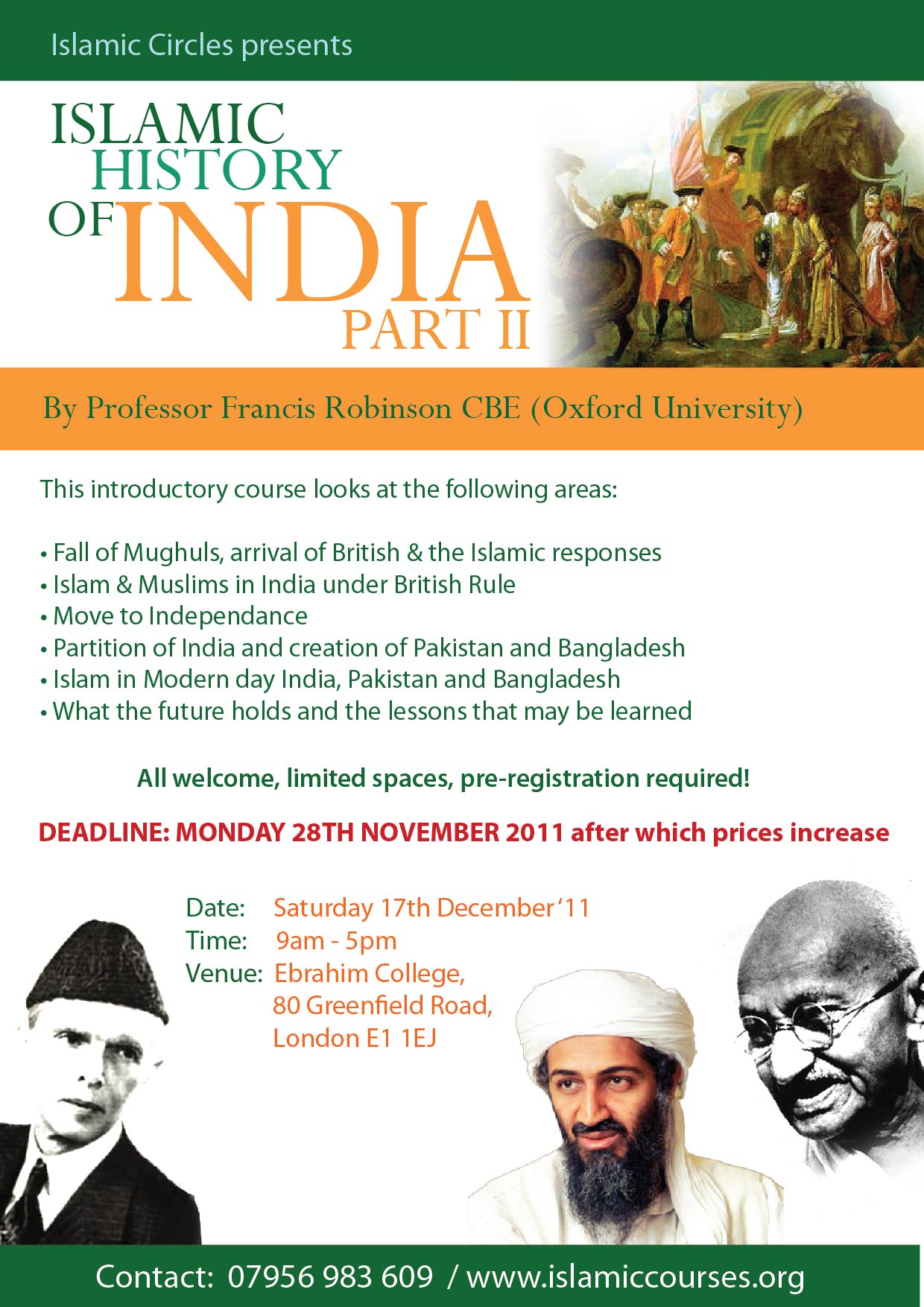
[Event London]: History of Islam in India Part II, Sat 17th Dec 2011

Bismillahir Rahmanir Rahim
In the name of Allah, the Most Beneficent, the Most Merciful

For bookings and more details http://islamiccourses.org/courses/islamic-history-of-india-part-2/


Abu Hurairah (May Allah be pleased with him) reported: Messenger of Allah (PBUH) said,
 "Hasten to do good deeds before you are overtaken by one of the seven afflictions.'' Then (giving a warning) he said, "Are you waiting for such poverty which will make you unmindful of devotion; or prosperity which will make you corrupt, or disease as will disable you, or such senility as will make you mentally unstable, or sudden death, or Ad-Dajjal who is the worst expected absent, or the Hour, and the Hour will be most grievous and most bitter".  
[At-Tirmidhi]
Friday, 23 September 2011

Here Is What I Wrote ... From My Heart

Bismillahir Rahmanir Rahim
In the name of Allah, the Most Beneficent, the Most Merciful


A Letter by Malcolm X, may Allâh have mercy upon him
Quoted from The Autobiography of Malcolm X printed by Penguin Classics


Never have I witnessed such sincere hospitality and overwhelming spirit of true brotherhood as is practiced by people of all colors and races here in this ancient Holy Land, the home of Abraham, Muhammad and all the other Prophets of the Holy Scriptures. For the past week, I have been utterly speechless and spellbound by the graciousness I see displayed all around me by people of all colors.

I have been blessed to visit the Holy City of Makkah, I have made my seven circuits around the ka'bah, led by a young religious guide (mutawaf) named Muhammad, I drank water from the well of the Zam-Zam. I ran seven times back and forth between the hills of Mt. as-Safa and al-Marwah. I have prayed in the ancient city of Mina, and I have prayed on Mt. Arafat.
There were tens of thousands of pilgrims, from all over the world. They were of all colors, from blue-eyed blondes to black-skinned Africans. But we were all participating in the same ritual, displaying a spirit of unity and brotherhood that my experiences in America had led me to believe never could exist between the white and non-white.

America needs to understand Islam, because this is the one religion that erases from its society the race problem. Throughout my travels in the Muslim world, I have met, talked to, and even eaten with people who in America would have been considered white - but the white attitude was removed from their minds by the religion of Islam. I have never before seen sincere and true brotherhood practiced by all colors together, irrespective of their color.

You may be shocked by these words coming from me. But on this pilgrimage, what I have seen, and experienced, has forced me to rearrange much of my thought-patterns previously held, and to toss aside some of my previous conclusions. This was not too difficult for me. Despite my firm convictions, I have always been a man who tries to face facts, and to accept the reality of life as new experience and new knowledge unfolds it. I have always kept an open mind, which is necessary to the flexibility that must go hand in hand with every form of intelligent search for truth.

During the past eleven days here in the Muslim world, I have eaten from the same plate, drunk from the same glass, and slept on the same rug - while praying to the same God - with fellow Muslims, whose eyes were the bluest of blue, whose hair was the blondest of blond, and whose skin was the whitest of white. And in the words and in the deeds of the white Muslims, I felt the same sincerity that I felt among the black African Muslims of Nigeria, Sudan and Ghana.

We were truly all the same (brothers) - because their belief in one God had removed the white from their minds, the white from their behaviour, and the white from their attitude.
I could see from this, that perhaps if white Americans could accept the Oneness of God, then perhaps, too, they could accept in reality the Oneness of Man - and cease to measure, and hinder, and harm others in terms of their 'differences' in color.

With racism plaguing America like an incurable cancer, the so-called 'Christian' white American heart should be more receptive to a proven solution to such a destructive problem. Perhaps it could be in time to save America from imminent disaster - the same destruction brought upon Germany by racism that eventually destroyed the Germans themselves.

Each hour here in the Holy Land enables me to have greater spiritual insights into what is happening in America between black and white. The American Negro never can be blamed for his racial animosities - he is only reacting to four hundred years of the conscious racism of the American whites. But as racism leads America up the suicide path, I do believe, from the experiences that I have had with them, that the whites of the younger generation, in the colleges and universities, will see the handwriting on the walls and many of them will turn to the spiritual path of truth - the only way left to America to ward off the disaster that racism inevitably must lead to.

Never have I been so highly honored. Never have I been made to feel more humble and unworthy. Who would believe the blessings that have been heaped upon an American Negro? A few nights ago, a man who would be called in America a white man, a United Nations diplomat, an ambassador, a companion of kings, gave me his hotel suite, his bed. Never would I have even thought of dreaming that I would ever be a recipient of such honors - honors that in America would be bestowed upon a King - not a Negro.
All praise is due to Allah, the Lord of all the Worlds.

Sincerely,

Al-Hajj Malik El-Shabazz (Malcolm X)


Abu Hurairah (May Allah be pleased with him) reported: Messenger of Allah (PBUH) said,
 "Hasten to do good deeds before you are overtaken by one of the seven afflictions.'' Then (giving a warning) he said, "Are you waiting for such poverty which will make you unmindful of devotion; or prosperity which will make you corrupt, or disease as will disable you, or such senility as will make you mentally unstable, or sudden death, or Ad-Dajjal who is the worst expected absent, or the Hour, and the Hour will be most grievous and most bitter".  
[At-Tirmidhi]

Tuesday, 3 March 2009

[Audio Download] Yusuf (AS) - Exploring the Chapter of Joseph in the Holy Quran

Bismillahir Rahmanir Rahim

In the name of Allah, the Most Beneficent, the Most Merciful

Yusuf (AS) - Exploring the Chapter of Joseph in the Holy Quran


This 4 CD set aims to show how the story of Yusuf (AS) int he Holy Qur'an can be a source of guidance and inspiration for today. It goes beyond the usual verse-by-verse commentaries and instead focuses on the major themes of his life; his childhood in Palestine; his life in the palace of al-Aziz; his time in prison; and finally his ascension to power in Egypt. Presented by the renowned historian Dr Hesham Al Awadi, who has researched numerous works on the chapter of Joseph in the Holy Qur'an, this CD set captures with vividness prophet Yusuf's (AS) various encounters with jealousy, greed, seduction, injustice and the allures of power and fame. In a style that combines both depth and practicality, the story is relayed and reinvigorated to relate to our modern lives.


Download


The Prophet sal Allahu alayhi wa'sallam said:

"The Muslim is a unique Ummah among the whole of mankind:
Their Land is ONE, their War is ONE, their Peace is ONE,
Their Honour is ONE and their Trust is ONE."
[Ahmad]

Thursday, 15 January 2009

[Video] Salah ad Din Cartoon (short clip)

Bismillahir Rahmanir Rahim

In the name of Allah, the Most Beneficent, the Most Merciful


The Prophet sal Allahu alayhi wa'sallam said:

"The Muslim is a unique Ummah among the whole of mankind:
Their Land is ONE, their War is ONE, their Peace is ONE,
Their Honour is ONE and their Trust is ONE."
[Ahmad]

Sunday, 13 January 2008

[Video] Islam: Empire of Faith

Bismillahir Rahmanir Rahim


In the name of Allah, the Most Beneficent, the Most Merciful


Islam: Empire of Faith


Part 1


What is Islam? Who is Muhammad (peace be upon him)? This is the first of 3 part documentary narrated by Ben Kingsley about Islam and attempts to answer these questions.


This part deals with the life of the Prophet Muhammad (peace be upon him), his early life, his encounter with God Almighty and the birth of the Islam. Islam would become the revitalizing force of a barbaric Arabia, returning people to God and bringing back the monotheistic message of Christianity and Judaism in its most powerful way.: Islam Women were given rights over there husbands, racism was annihilated and the rich were made equal to the poor. This religion is the solution to all of humanities problems and it is important to learn about it today.


Part 2


This part relates the goldenage of Islam. A time of great learning when Europe was steeped in the Dark Ages. The building of great works of architecture, reading, writing, mathematics, medicine, and astronomy. Even before the printing press Muslims would have hundreds of scribes writing all at once so they would learn and reproduce the writings.


Part 3


This portion deals with the growing Ottoman Empire, which would control the bridge between 3 continents: Africa, Europe and Asia. This empire would begin at the close of the Crusades until World War I, from the 1300s to 1923. They would rule the entire Middle East and make there way into Europe. Before there was the state of Israel, there was great peace in the Holy Land regulated by the Ottomans.


The Prophet sal Allahu alayhi wa'sallam said:


"The Muslim is a unique Ummah among the whole of mankind:

Their Land is ONE, their War is ONE, their Peace is ONE,>
Their Honour is ONE and their Trust is ONE."

[Ahmad]

Thursday, 8 November 2007

Video: The Message

Bismillahir Rahmanir Rahim


In the name of Allah, the Most Beneficent, the Most Merciful


The Message is a film chronicling the life and times of the final Prophet, Muhammad, peace be upon him.


The Prophet sal Allahu alayhi wa'sallam said:


"The Muslim is a unique Ummah among the whole of mankind:

Their Land is ONE, their War is ONE, their Peace is ONE,

Their Honour is ONE and their Trust is ONE."

[Ahmad]

Tuesday, 24 April 2007

The Lion of Syria...

Bismillahir Rahmanir Rahim


In the name of Allah, the Most Beneficent, the Most Merciful


The Lion Of Syria

Background:


Khaalid bin Al-Waleed had besieged Damascus. He had sent a Muslim blocking force to the north to prevent Roman reinforcements from coming to replenish the garrison at Damascus. At the head of this army was the commander Dhiraar - the lion of Syria who used to fight amongst the armoured enemies of Islaam naked from the waist up! He was a fierce warrior who had unfortunately been captured by the Roman reinforcements since their army was twice the strength of the Muslims, and he had launched headlong into the ranks of the enemies by himself, killing so many of the foe that his companions could not keep up with the pace. Soon he was too far into the ranks of the Romans, and was surrounded and captured. Khaalid bin Al-Waleed, upon hearing this, mobilized 5,000 from amongst the besieging force at Damascus and rode like the wind to come to the aid of the Muslims.


As Khalid approached the battlefield he suddenly saw a Muslim rider flash past him from behind and gallop off towards the Roman front. Before Khalid could stop him, he was gone. A slim, lightly-built person, dressed in black, this rider wore a breastplate and was armed with a sword and a long lance. He sported a green turban and had a scarf wrapped around his face, acting as a mask, with only his eyes visible. Khalid arrived on the battlefield in time to see this rider throw himself at the Romans with such fury that everyone present thought that he and his horse must both be mad. Raafe saw this rider before he saw Khalid and remarked, "He attacks like Khalid, but he is clearly not Khalid." Then Khalid joined Raafe. (second in command)


Khalid took a little time to organize Raafe's group and his own Mobile Guard into one and deploy it as a combined force for battle. Meanwhile the masked rider treated the Muslims to a thrilling display of horsemanship and attacks with the lance. He would go charging on his own, strike the Roman front atone point and kill a man; then go galloping away to another part of the front, again strike someone in the Roman front line and so on. A few Romans came forward to tackle him but all went down before his terrible lance. Marvelling at this wondrous sight, the Muslims could still see nothing more of the warrior than a youthful figure and a pair of bright eyes shining above the mask. The rider appeared bent on suicide as with his clothes and lance covered with blood, he struck again and again at the Romans. The example of this warrior put fresh courage into the men of Raafe, who forgot their fatigue and went into battle with renewed high spirits as Khalid gave the order to attack.


The masked rider, now joined by many others, continued his personal war against the Romans as the entire Muslim force attacked the Roman front. Soon after the general attack had begun, Khalid got near this rider and called, "O warrior, show us your face." A pair of dark eyes flashed at Khalid before the rider turned away and galloped off into another assault at the Romans. Next, a few of Khalid's men caught up with him and said,


"O noble warrior, your commander calls you and you turn away from him! Show us your face and tell us your name so that you may be properly honoured."


Again the rider turned away as if deliberately trying to keep his identity a secret.


As the masked rider returned from his charge, he passed by Khalid, who called to him sternly to stop. The rider pulled up his horse, and Khalid continued, "You have done enough to fill our hearts with admiration. Who are you?"


Khalid nearly fell off his horse when he heard the reply of the masked rider, for it was the voice of a girl! "


O commander, I only turn away from you out of modesty. You are the glorious commander, and I am of those who stay behind the veil. I fight like this because my heart is on fire."


"Who are you?"


"I am Khaulah, sister of Dhiraar. My brother has been captured, and I must fight to set him free."


The Prophet sal Allahu alayhi wa'sallam said:


"The Muslim is a unique Ummah among the whole of mankind:

Their Land is ONE, their War is ONE, their Peace is ONE,

Their Honour is ONE and their Trust is ONE."

[Ahmad]

Friday, 19 January 2007

The history of Islam in Japan

Bismillahir Rahmanir Rahim


In the name of Allah, the Most Beneficent, the Most Merciful


The history of Islam in Japan


Islam’s relation with Japan is quite recent as compared to those with other countries around the world.


There are no clear records of any contact between Islam and Japan nor any historical traces of Islam’s coming into Japan through religious propagation of any sort except for some isolated cases of contact between individual Japanese and Muslims of other countries before 1868.


First Japanese Muslims


Islam was firstly known to Japanese people in 1877 as a part of Western religious thought. Around the same time the life of prophet Muhammad (pbuh) was translated into Japanese. This helped Islam to find a place in the intellectual image of the Japanese people, but only as a knowledge and a part of the history of cultures.


Another important contact was made in 1890 when Ottoman Turkey dispatched a naval vessel to Japan for the purpose of starting diplomatic relations between the two countries as well introducing Muslims and Japanese people to each other. This naval vessel, called "Ertugrul", was capsized and sank with 609 people aboard, drowning 540 of them, on its return journey.


The first Japanese Muslims ever known are Mitsutaro Takaoka, who converted to Islam in 1909 and took the name Omar Yamaoka after making the pilgrimage to Makkah, and Bumpachiro Ariga, who about the same time went to India for trading purposes and converted to Islam under the influence of local Muslims there and subsequently took the name Ahmad Ariga. However, recent studies have revealed that another Japanese known as Torajiro Yamada was probably the first Japanese Muslim who visited Turkey out of sympathy for those who died in the aftermath of the shipwreck of the "Ertugrul". He converted to Islam there and took the name Abdul Khalil and probably made pilgrimage to Makkah.


Muslim Community


Real Muslim community life however did not start until the arrival of several hundred Turkoman, Uzbek, Tadjik, Kirghiz, Kazakh and other Turko-Tatar Muslim refugees from central Asia and Russia in the wake of the Bolshevik Revolution during World War I. These Muslims who were given asylum in Japan settled in several main cities and formed small Muslim communities. A number of Japanese converted to Islam through contact with these Muslims.


With the formation of these small Muslim communities several mosques have been built, the most important of them being the Kobe Mosque built in 1935 and the Tokyo Mosque built in 1938. One thing that should be emphasized is that very little weight of Japanese Muslims was felt in building these mosques and there have been no Japanese so far who have served as Imams of any of the mosques.


During World War II, an "Islamic Boom" was set in Japan by the military government through organisations and research centres on Islam and the Muslim World. It is said that during this period over 100 books and journals on Islam were published in Japan. However, these organisations or research centres were in no way controlled or run by Muslims nor was their purpose the propagation of Islam. The mere purpose was to enable the military to be better equipped with the necessary knowledge about Islam and Muslims since there were large Muslim communities in the areas occupied in China and Southeast Asia by the Japanese army. As a result, with the end of the war in 1945, these organisations and research centres disappeared rapidly.


Another "Islamic Boom" was set in motion this time in the shade of the "Arab Boom" after the "oil shock" in 1973. The Japanese mass media gave a lot of publicity to the Muslim World in general and the Arab World in particular after realizing the importance of these countries to the Japanese economy. With this publicity many Japanese who had no idea about Islam got the chance to see the scene of Hajj in Makkah and hear the call of the Adhan and Quranic recitations. Besides many sincere conversions to Islam, there were also mass conversions which are said to have amounted to several tens of thousands which took place during those days. However, with the end of the effect of the oil shock, most of those who converted to Islam disappeared from the scene.


Towards a new phase


"In the coming few years there should be substantial developments for Islam in Japan,"says Nur Ad-Din Mori."If not, then we cannot really speak of the future of Islam in this country." Mori maintains it is a turning point now because of the relatively recent return of five young Muslims to Japan after completing their studies on Islam in Arab countries. Two graduated from the Umm al-Qura University, Makkah, one from Islamic University, Madinah, one from the Dawa College, Tripoli, and the last from Qatar University. Though the number may not seem very impressive it is a significant increase in the Japanese scene where, before these five, only six students graduated from universities in Arab countries during the last twenty years, with three of them majoring in Arabic, not Islamic, studies.


The Turks have been the biggest Muslim community in Japan until recently.


Pre-war Japan was well-known for its sympathy and favour towards Muslims in central Asia, seeing in them an anti-Soviet ally. In those days some Japanese who worked in intelligence circles had contact with these Muslims. A few opened their eyes to Islam through these contacts, and embraced it after the war ended. There were also those who went to Southeast Asian countries such as Malaysia as soldiers during the war. The pilots were instructed to say "La ilaha illa Allah", when they were shot down in these regions, so that their lives would be spared. Actually one of them was shot down and captured by the inhabitants. When he shouted the "magic" words to them, to his astonishment they changed their attitudes and treated him rather kindly.


He has been keeping to those words until this day.


These are the Muslims of "the old generation". They found themselves as a minority group of Japanese Muslims after the war, and lived with already established foreign Muslim communities. Generally, the Japanese in those days had quite strong prejudices against Islam and their knowledge of international society was very limited. For example, in an article published in a magazine in 1958, the five pillars of Islam were described under the title "The strange customs of Mohammedans". The Japanese had a stereotyped image of Islam that it was "a strange religion of underdeveloped countries". Even these days, though modified and corrected in many respects, such an image has not died out. Just a few years ago, a famous writer in social affairs could say in a TV program that Islam is a religion whose followers worship the sun!


The Japanese invasion of China and South East Asian countries during the second world war brought the Japanese in contact with Muslims. Those who embraced Islam through them established in 1953, the first Japanese Muslim organisation, the Japan Muslim Association under the leadership of the late Sadiq Imaizumi. Its members, numbering sixty five at the time of inauguration, increased two-fold before this devoted man passed away six years later.


It was only after the second world war, that what can properly be called "a Japanese Muslim community" came into existence. In spite of the initial success, however, later developments were quite slow in terms of membership. Though many Islamic organisations were established since the 1900s, each of them has only a few active members.


Muslim Population


There is no reliable estimate on the Japanese Muslim population. Claims of thirty thousand are without doubt an exaggeration. Some claim that there are only a few hundred. This probably amounts to the number of Muslims openly practicing Islam. Asked to give an estimate on the actual number of Muslims in Japan, Abu Bakr Morimoto replied, "To say frankly, only one thousand. In the broadest sense, I mean, if we do not exclude those who became Muslims for the sake of, say marriage, and do not practice then the number would be a few thousands." Apparently such a slow development is due partly to external circumstances. Japanese traditional religious atmosphere and highly developed materialistic tendencies must both be taken into consideration. But there are also shortcomings on the part of the Muslims.


When visiting Muslim countries, the remark that Japanese Muslims are the minority religious group always brings a question from the audience, "What percentage of Japan’s total population are Muslims?" The answer at the moment is: One out of a hundred thousand. Nevertheless, the younger generation has aspirations. Perhaps some day it will be said that Islam is a popular religion in Japan.


The misconception of Islamic teachings introduced by the western media stands to be corrected in a more efficient approach that takes into consideration the significant feature of the Japanese society of being one of the world’s most literate countries. Yet, because of poor distribution, even translations of the meanings of the Quran into Japanese language are not publicly available. Islamic literature is virtually absent from bookstores or public libraries to the exception of few english-written essays and books that are sold at relatively high prices.


As a result, it should not be surprising to find out that the knowledge of ordinary Japanese about Islam is modestly confined to few terms related to polygamy, Sunnah and Shia, Ramadhan, Makkah, Allah the God of Muslims and Islam the religion of Muhammad! Will Islam echo louder in Japan? With increasingly significant evidence of a responsible recognition of its duties and rational assessment of its limits and capabilities, the Muslim community is showing stronger commitment to accomplish its task of da’wah in a better organised fashion. There are indeed strong hopes that the future of Islam and Muslims will be better than their past insha’Allah as we believe that if Allah (swt) helps us, none can overcome us.


Prepared by:


• Br. Nabil Bin Mohammed El-Maghrabi, OSAKA - JAPAN


• Br. Mohamed Ahmed Soliman, KYOTO - JAPAN


• Br. Mehmet Arif Adli, NAGOYA - JAPAN


Source


The Prophet sal Allahu alayhi wa'sallam said:


"The Muslim is a unique Ummah among the whole of mankind:

Their Land is ONE, their War is ONE, their Peace is ONE,

Their Honour is ONE and their Trust is ONE."

[Ahmad]

Sunday, 3 December 2006

Ali Bin Abi Taalib: Ali Bin Abi Talib's Advice

Bismillahir Rahmanir Rahim


In the name of Allah, the Most Beneficent, the Most Merciful


Ali Bin Abi Taalib: Ali Bin Abi Talib's Advice


Abdu-Rahman bin Jandab narrated that Kamil bin Ziyad told him:

" Ali (may Allah be pleased with him) held my hand once, and he walked with me in the direction of the cemetery. When we reached the open desert, he soughed a deep breath before he said to me,


'O Kamil son of Ziyad, hearts are like vessels, the best are exceptionally conscious and vast. Learn from what I am going to tell you. There are three types of people ..


(1) A godly scholar,

(2) a student who is seeking salvation, and


(3) a ferocious follower of every howler and his own type.


The third type of people are biased, and they float with the currents. They neither seek enlightenment through knowledge, nor do they take refuge in a safe recess during a storm.
You must understand that knowledge is better than money, for knowledge will guard you, while you have to be the guard of your money. Deeds are more exalted than knowledge, while money needs someone to spent it justly in order to render it pure. To love a man of knowledge and to learn at his hand is a debt one can never repay. Knowledge earns its owner respect during his lifetime and praiseworthy remembrance after his death, while what money can do expires once it is spent. The keever of a safe dies and what he guards and the treasures remain, however, a men of knowledge lives throughout the ages.


Their distinct form may no longer be seen, but their findings are preserved in people's hearts. Although knowledge is preserved in the hearts, yet if it is acted upon, it will carry its bearer, otherwise when merely memorized, knowledge remains vulnerable. (Another) person may use his religious knowledge for worldly gains ... like that, knowledge dies away when its carrier dies.


However, the earth will never remain devoid of someone who carries the proof of God's sovereignty, and the testimony of His messenger otherwise, God's revelations and clear signs will be abrogated. Such true human beings are the rare few, although they are the most exalted in God's sight. Through them, Almighty Allah guards His message, and He will not take them back unto Himself until they have delivered the same to their coequals. These people endeavor to plant such seeds in hearts akin to their own. Hence, knowledge gushes forth from their hearts, and they take from it the terrain the opulent ones judge as rugged and what the ignorant ones deem as reprehensible. In fact God's people live in this world with bodies who's souls are captivated by the Supreme Observer of all. Such are God's vice-regents on earth, and such are the callers to His religion. Ah, ah! I yearn to meet them, and I ask for God's forgiveness for me and for you. Now if you wish we may go back."


From "The Beauty of the Righteous And Ranks Of The Elite"
(Hilyat-ul Awliya Wa Tabaqat al-Asfiya)


The Prophet sal Allahu alayhi wa'sallam said:

"The Muslim is a unique Ummah among the whole of mankind:

Their Land is ONE, their War is ONE, their Peace is ONE,

Their Honour is ONE and their Trust is ONE."

[Ahmad]

Khalid Bin Al-Waleed: We are people who drink blood

Bismillahir Rahmanir Rahim


In the name of Allah, the Most Beneficent, the Most Merciful


Khalid Bin Al-Waleed: We are people who drink blood


When Khalid bin Waleed (may Allah be pleased with him) reached Yarmook with his army to fight the Romans, he addressed them saying:


"Oh mujahideen! This is a memorable day. It is the day on which our faith will be tested and tried. Today we should avoid every kind of arrogance, pride and not contend for individual glory or egoistic bragging..


Oh mujahideen of Islam! Fight only to gain the Goodwill of Allah Almighty. In the Muslim army today there are many great generals: each of them is worthy and can be entrusted with the permanent command of this army. Today you have assigned me this honor of commanding the Muslim army. So I hope that for the honor and victory of Islam, today we will enter the battlefield of Jihad as one. Allah will be our Supporter and Defender."


Then both the armies confronted each other at Yarmook. The Roman general, Mahan, scornful addressed his counterpart, Khalid bin Waleed (may Allah be pleased with him) and said:


"It looks as if poverty, nakedness and starvation has compelled you to come here. If you wish I am willing to give each of you ten dinars, expensive clothing and good food. You can take these things and leave. Next year too I can send you these things; you do not have to take the trouble to come here."


Khalid bin Waleed (may Allah be pleased with him) was enraged on hearing these scornful and arrogant words, and answered:


"Mahan listen to me very carefully! You are mistaken about the reason why we are here. We are people who drink the blood of our opponents. We have heard that Roman blood is very delicious, and we have come here to enjoy it."


From Commanders of The Muslim Army By Mahmood Ahmad Ghandanfar


The Prophet sal Allahu alayhi wa'sallam said:


"The Muslim is a unique Ummah among the whole of mankind:

Their Land is ONE, their War is ONE, their Peace is ONE,

Their Honour is ONE and their Trust is ONE."

[Ahmad]

Thursday, 30 November 2006

The Four Imams: Imam Ahmed bin Hanbal

Bismillahir Rahmanir Rahim


In the name of Allah, the Most Beneficent, the Most Merciful


Imam Ahmed bin Hanbal


The four Imam's - Imam Abu Hanifa, Imam Malik, Imam Ahmed bin Hanbal and Imam Shafi - are the main figures who's interpretation of the Hadith and Qur’an are followed by the majority of Sunni Muslims all over the world. They are therefore of great importance to the correct practice of Islam.


Imaam Ahmad ibn Mohamed Ibn Hanbal, Abu `Abd Allah al-Dhuhli Al-Shaybani al-Marwazi al-Baghdadi (d. 241).


Imam Ahmed ibn Hanbal (780 - 855) was among the great Muslim scholars and theologians. He is the founder of the Hanbali school of fiqh. His full name was Ahmed bin Muhammad Hanbal.


Imam Hanbal was born in Central Asia to Arab parents in 780. After his father died, he moved to Iraq and studied extensively in Baghdad, and later used his travels for further education. He was mainly interested in the science of Hadith and traveled extensively through Iraq, Syria, and Arabia studying religion and collecting traditions of Prophet Mohammad (PBUH).


His travels lasted several years. Upon returning home, he studied under Imam Shafi on Islamic law. Imam Hambal was very devoted to traditional views and was opposed to innovations in Islamic law.


Imam ibn Hanbal became very well known all, and his teachings spread worldwide. His learning, piety and unswerving faithfulness to traditions gathered a lot if admirers around him.


From the biographical notice on Imam Ahmad in the Reliance of the Traveler:


"Out of piety, Imam Ahmad never gave a formal legal opinion (fatwa) while Imam Shafi`i was in Iraq, and when he later formulated his school of jurisprudence, he mainly drew on clear texts from the holy [Qur’an], Hadith, and scholarly agreement, with relatively little expansion from analogical reasoning (qiyâs). He was probably the most learned in the sciences of Hadith of the four great Imams of Sacred Law; Imam Abu Hanifah, Imam Al Shafi`i`, Imam Malik, and him Imam Ahmad Ibn Hanbal.


His students included many of the foremost scholars of Hadith. Abu Dawud said of him: ‘Ahmad’s gatherings were gatherings of the afterlife: nothing of this world was mentioned. Never once did I hear him mention this-worldly things.’


... Imam Ahmad never once missed praying in the night, and used to recite the entire [Qur’an] daily. Imam Ahmad was imprisoned and subjected to various forms of torture for twenty-eight months under the Abbasid caliph al-Mu`tasim in an effort to force him to publicly support the [Mu`tazila] position that the Holy [Qur’an] was created, but the Imam refused to give up the belief that the [Qur’an] is the uncreated word of Allah, after which Allah delivered and vindicated him.


… When Imam Ahmad died in 241/855, he was accompanied to his resting place by a funeral procession of eight hundred thousand men and sixty thousand women, marking the departure of the last of the four great mujtahid Imams of Islam."


Al-Dhahabi describes him saying:


"The true Sheikh of Islam and leader of the Muslims at his time, the Hadith master and proof of the Religion. He took Hadith from Hushaym, Ibrahim ibn Sa`d, Sufyan ibn `Uyayna, `Abbad ibn `Abbad, Yahya Ibn Abi Za’ida, and their layer. From him narrated al-Bukhari [two Hadiths in the Sahih], Muslim [22], Abu Dawud [254], Abu Zur`a, Mutayyan, `Abd Allah ibn Ahmad, Abu al-Qasim al-Baghawi, and a huge array of scholars. His father was a soldier one of those who called to Islam and he died young."- Al-Dhahabi continues.


Ibn al-Jawzi relates in al-Manaaqib (p. 192):


"Imaam Ahmad was the foremost among the Imams in collecting the Sunnah and sticking to it."


`Abd Allah ibn Ahmad said:


"I heard Abu Zur`a [al-Razi] say: ‘Your father had memorized a million Hadiths, which I rehearsed with him according to topic.’"


Hanbal said:


"I heard Abu `Abd Allah say: ‘I memorized everything which I heard from Hushaym when he was alive.’"


Ibrahim al-Harbi said:


"I held Ahmad as one for whom Allah had gathered up the combined knowledge of the first and the last."


Imam al-Shafi`i said:


"You (addressing Imaam Ahmad ibn Hanbal) are more knowledgeable about Hadith than I, so when a hadith is sahih (correct), inform me of it, whether it is from Kufah, Basrah or Syria, so that I may take the view of the hadith, as long as it is sahih.


Related by Ibn Abi Haatim in Aadaab ash-Shaafi'i (pp. 94-5),


Harmala said:


"I heard Imaam al-Shafi`i say: ‘I left Baghdad and did not leave behind me anyone more virtuous (afdal), more learned (a`lam), more knowledgeable (afqah) than Ahmad ibn Hanbal.’"


`Ali ibn al-Madini said about Imam Ahmed Ibn Hanbal:


"Truly, Allah reinforced this Religion with Abu Bakr al-Siddiq the day of the Great Apostasy (al-Ridda), and He reinforced it with Ahmad ibn Hanbal the day of the Inquisition (al-Mihna)."


Abu `Ubayd said:


"The Science at its peak is in the custody of four men, of whom Ahmad ibn Hanbal is the most knowledgeable."


Ibn Ma`in said, as related by `Abbas [al-Duri]:


"They meant for me to be like Ahmad, but by Allah! I shall never in my life compare to him."


A lot of great scholars who followed the approach (Madhab) of Imam Ahmad Ibn Hanbal.


Ibn ul-Qayyim al-Jawziyyah says in his book Imam Bukhari, Imaam Muslim and Imaam Abu Dawood were strong followers of Imam Ahmad Ibn Hambal. Among other great Imams who followed the teachings of Imam Ahmad include Shaikh-ul-Islam Taqi ad-Deen Ibn Taymiyyah, Abdul Qadir Jillaani, Ibn ul-Qayyim al-Jawziyyah, Al-Haafidh Zaynud-Deen Ibn Rajab al-Hanbali, Imam Muhammed Bin Abdul Wahab and Imam Ibn ul Jawzi.


Ibn al-Jawzi narrates from Bilal al-Khawass that the latter met al-Khidr and asked him: "What do you think of al-Shafi`i?" He said: "One of the Pillar-Saints (Awtâd)." " What about Ahmad Ibn Hanbal?" "He is a Siddiq."


Ibn al-Jawzi also narrates that Imam Ahmad ibn Hanbal said:


"Whoever rejects a statement of Prophet Mohammad (PBUH) is on the brink of destruction." and was the foremost in sticking to the Sunna and sahih hadith.


Among Imam ibn Hanbal’s works is the great encyclopedia of Traditions called Musnad, collected by his son from his lectures and amplified by supplements - containing over twenty eight thousand traditions. Other works include Kitab-us-Salat, on the Discipline of Prayer and Kitab-us-Sunnah, on the Traditions of Prophet Mohammad (PBUH).


Main sources: al-Dhahabi, Siyar A`lam al-Nubala’ 9:434-547 #1876 and Tadhkira al-Huffaz 2:431 #438.


Source


The Prophet sal Allahu alayhi wa'sallam said:

"The Muslim is a unique Ummah among the whole of mankind:

Their Land is ONE, their War is ONE, their Peace is ONE,

Their Honour is ONE and their Trust is ONE."

[Ahmad]

Wednesday, 29 November 2006

The Four Imams: Imam Al Shafi'i

Bismillahir Rahmanir Rahim


In the name of Allah, the Most Beneficent, the Most Merciful


Imam Al-Shafi'i


The four Imam's - Imam Abu Hanifa, Imam Malik, Imam Ahmed bin Hanbal and Imam Shafi - are the main figures who's interpretation of the Hadith and Qur’an are followed by the majority of Sunni Muslims all over the world. They are therefore of great importance to the correct practice of Islam.


He is Abdullah Mohamed Ibn Idris Al Shafi’i, a prominent Imam who was a descendant from the Hashimi family of Quraysh tribe, which Prophet Mohamed (PBIUH) came from.


He is known as the revivalist of the second century, for he was the one who put the fundamental of jurisprudence; science of (usul al Fiqh).


At the age of 10, Al Shafi’i mother sent him to Mekkah, near his tribal ancestry. After entrusting him initially in the care of a relative, she followed him there to keep an eye on his studies.


As he could not afford enough writing material, Al Shaafi’i used to go to the governor’s offices in search of paper that had already been used. On the blank side of the paper, he would do his lessons. He memorized the Qur’an at a very young age.


In order to improve his knowledge of Arabic, he went deep into the desert to join the Bedouin tribe of Huthail, who were renowned for the best standard of literary Arabic. He studied poetry and learnt their prose reporting and stories. He accompanied the tribe on nomadic travels, until he mastered all that was there to learn. He also learnt archery and became very skilful; he could hit the target 10 times out of 10.


On his return to Mekkah Al Shafi’i continued studying. At the age of 20 he had completed all that its scholars has to teach, but this thirst for knowledge was not quenched. So, he traveled to Madinah to learn from Imam Malik.


Al Shafi’i wished to have a foretaste of what he would be learning. He borrowed Al-Muwatta’ to read which even fueled him more made him more eager to study under Imam Malik.


Al-Shafi’i stayed very closed to Malik for nine years, he never left him during those nine years except to visit his mother, or to stay for a short while with some bedouin tribes. The last three years at Malik’s study circle were doubly fruitful because the eminent Iraqi scholar. Muhammad ibn Al-Hasan Al-Shaibani (132-189H) who recorded all the Hanafi scholarship had come to study under Malik.


Imam Malik used to care more and give more attention to poor and needy students. Al-Shafi’i was one of them. When Malik died (179H), Al-Shafi’i returned to Mekkah hoping to earn his living. Some people asked the governor of Yemen to help Al-Shafi’i, and so he took him to Yemen where he was appointed justice in the city of Najran. The people there soon realised that they had a judge who was devoted to justice, unwilling to swerve from it for any favor or pressure. They respected him so much and learnt a great deal from him.


In his fifth years at Najran, Al-Shafi’i’s mettle was tasted when a strong-fisted governor took over. Al-Shafi’i did not spare him from criticism whenever the occasion arose. In the process of curbing the governor’s injustice, Al-Shafi’i earned his enmity.


The governor wrote to Caliph Al-Rasheed in Baghdad, accusing Al-Shafi’i of backing a revolt by people loyal to the Alawis, the descendants of Ali ibn Talib (may Allah be pleased with him). He said:


‘I have no authority over this man, and he achieves by his tongue much more than a fighter can achieve with this sword.’


Was this accusation false? Indeed it was, for Al-Shafi’i never supported or advocated any revolt or rebellion against the Caliph. On the contrary he used to love the Alawis, as they were the descendants of Ali, (may Allah be pleased with him), and Fatimah, (,ay Allah be pleased with her), the daughter of Prophet Mohammad, (PBUH).


At the age of 34, Imam Al-Shafi’i was brought in 184H before the Caliph in Baghdad, in fetters and chains. Muhammad ibn Al-Hasan Al-Shaibani, the Chief Justice was his the only of his advisers and top officials present at the court. Two factors affected the Caliph’s Judgement: a lucid defence by the accused himself; and Chief Justice Muhammad ibn Al-Hasan Al-Shaibani’s Testimony. Al-Shafi’i pointed out that his scholarship was known to the Chief Justice, who described Al-Shafi’i as a scholar of eminence who would not be involved in such matters.


Caliph Al-Rasheed, known to be kind and merciful, saw in this testimony his way out to spare Al-Shafi’i. He told Muhammad ibn Al-Hasan Al-Shaibani to take Al-Shafi’i to his home while he thought the matter over. There the case ended. The charge was never revived. The governor who had rid himself of a fearless critic was no longer interested what happened to him.


This episode was a blessing in disguise because it brought Al-Shafi’i back on track in his quest for knowledge. Al-Shafi’i stayed with Muhammad ibn Al-Hasan Al-Shaibani and read under his guidance all the books that he had written, recording the Fiqh of Imam Abu Haneefah ( one of the Four grand Imams) and his disciples. After two years, Al Shaafi’i left Baghdad, he said:


‘I carried with me a whole camel load of books, all of which I learnt directly form Muhammad ibn Al-Hasan.’

Al-Shafi’i learnt the Fiqh in Baghdad as well as memorized the Ahadith that were known in Iraq, but not in Madinah or Mekkah. He also entered into debate with many scholars, speaking as a student of Imam Malik, but he would only debate with lesser scholars than Muhammad ibn Al-Hasan Al-Shaibani, whom he gave great respect.


Among the most important characteristic of Al-Shafi’i was his native intelligence that gave him an easy and good grasp of even the most difficult of questions. He always studied matters in depth, so as to reach the right solution and the right answer regarding any question put to him. His cleverness was coupled with a superb memory and ready argument.


When discussing any matter, Imam Al-Shafi’i would put it with a wealth of meanings that he always found ready to hand, his explanation was always rich and to the point.


Al-Shafi’i had a unique exquisite literary style, lucidity of expression and command over the language. His very clear use of words made him a influential speaker. One of his students said:


‘Every scholar gives more in his books than when you meet him personally, except for Al-Shafi’i whose verbal discussion gives you more than his books.’


Imam Al-Shafi’i’s books are among the finest in style, eloquence and presentation.


Another quality that positioned Al-Shafi’i at the highest rank of Islamic scholars was his persistent devotion and sincerity in the pursuit of truth, and declaring it even if it was unpopular, or at variance with his teacher, to whom he was most devoted. His gratitude to Muhammad ibn Al-Hasan, who had saved him from the Caliph’s wrath, did not prevent him from supporting the Madinan scholars’ views. No one ever accused him of rejecting true evidence.


Imam Al-Shafi’i used to urge his students to devote both their time and effort in studying the Hadith.


Imam Al-Shafi’i never got furious while debating with anyone, because he was not interested in scoring points or winning people’s admiration, but rather in reaching the truth. And if his opponent were right, he would not find any difficulty accepting his view.


He was quoted as saying:


‘I wish people would learn what I have to give, without it being attributed to me. In this way, I will receive the reward for it from Allah, without having people’s praise.’


With such noble qualities and wealth or knowledge, no wonder that scholars placed Imam Muhammad ibn Idris Al-Shafi’i in the highest rank.


The Prophet sal Allahu alayhi wa'sallam said:


"The Muslim is a unique Ummah among the whole of mankind:

Their Land is ONE, their War is ONE, their Peace is ONE,

Their Honour is ONE and their Trust is ONE."

[Ahmad]