Wednesday, 25 April 2007

Event: The Many Faces of a Detainee: COMING SOON

Bismillahir Rahmanir Rahim


In the name of Allah, the Most Beneficent, the Most Merciful


The Prophet sal Allahu alayhi wa'sallam said:


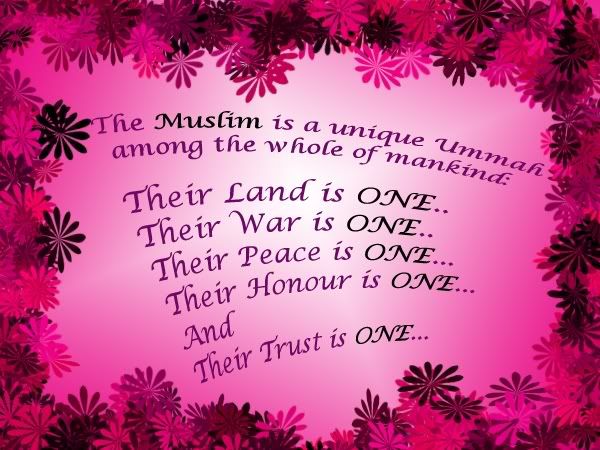
"The Muslim is a unique Ummah among the whole of mankind:

Their Land is ONE, their War is ONE, their Peace is ONE,

Their Honour is ONE and their Trust is ONE."

[Ahmad]

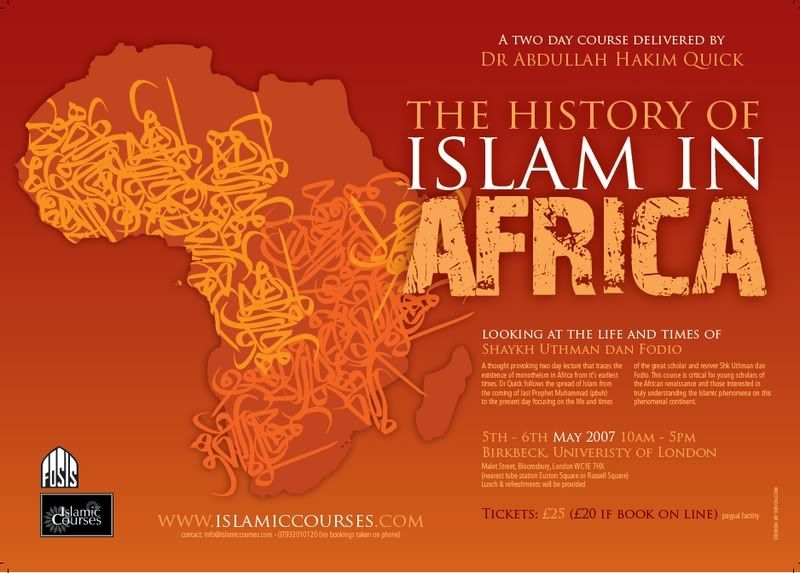
Event: History of Islam in Africa [London]

Bismillahir Rahmanir Rahim


In the name of Allah, the Most Beneficent, the Most Merciful


Click to enlarge image

Visit http://islamiccourses.com for more details


The Prophet sal Allahu alayhi wa'sallam said:


"The Muslim is a unique Ummah among the whole of mankind:

Their Land is ONE, their War is ONE, their Peace is ONE,

Their Honour is ONE and their Trust is ONE."

[Ahmad]

Tuesday, 24 April 2007

The Lion of Syria...

Bismillahir Rahmanir Rahim


In the name of Allah, the Most Beneficent, the Most Merciful


The Lion Of Syria

Background:


Khaalid bin Al-Waleed had besieged Damascus. He had sent a Muslim blocking force to the north to prevent Roman reinforcements from coming to replenish the garrison at Damascus. At the head of this army was the commander Dhiraar - the lion of Syria who used to fight amongst the armoured enemies of Islaam naked from the waist up! He was a fierce warrior who had unfortunately been captured by the Roman reinforcements since their army was twice the strength of the Muslims, and he had launched headlong into the ranks of the enemies by himself, killing so many of the foe that his companions could not keep up with the pace. Soon he was too far into the ranks of the Romans, and was surrounded and captured. Khaalid bin Al-Waleed, upon hearing this, mobilized 5,000 from amongst the besieging force at Damascus and rode like the wind to come to the aid of the Muslims.


As Khalid approached the battlefield he suddenly saw a Muslim rider flash past him from behind and gallop off towards the Roman front. Before Khalid could stop him, he was gone. A slim, lightly-built person, dressed in black, this rider wore a breastplate and was armed with a sword and a long lance. He sported a green turban and had a scarf wrapped around his face, acting as a mask, with only his eyes visible. Khalid arrived on the battlefield in time to see this rider throw himself at the Romans with such fury that everyone present thought that he and his horse must both be mad. Raafe saw this rider before he saw Khalid and remarked, "He attacks like Khalid, but he is clearly not Khalid." Then Khalid joined Raafe. (second in command)


Khalid took a little time to organize Raafe's group and his own Mobile Guard into one and deploy it as a combined force for battle. Meanwhile the masked rider treated the Muslims to a thrilling display of horsemanship and attacks with the lance. He would go charging on his own, strike the Roman front atone point and kill a man; then go galloping away to another part of the front, again strike someone in the Roman front line and so on. A few Romans came forward to tackle him but all went down before his terrible lance. Marvelling at this wondrous sight, the Muslims could still see nothing more of the warrior than a youthful figure and a pair of bright eyes shining above the mask. The rider appeared bent on suicide as with his clothes and lance covered with blood, he struck again and again at the Romans. The example of this warrior put fresh courage into the men of Raafe, who forgot their fatigue and went into battle with renewed high spirits as Khalid gave the order to attack.


The masked rider, now joined by many others, continued his personal war against the Romans as the entire Muslim force attacked the Roman front. Soon after the general attack had begun, Khalid got near this rider and called, "O warrior, show us your face." A pair of dark eyes flashed at Khalid before the rider turned away and galloped off into another assault at the Romans. Next, a few of Khalid's men caught up with him and said,


"O noble warrior, your commander calls you and you turn away from him! Show us your face and tell us your name so that you may be properly honoured."


Again the rider turned away as if deliberately trying to keep his identity a secret.


As the masked rider returned from his charge, he passed by Khalid, who called to him sternly to stop. The rider pulled up his horse, and Khalid continued, "You have done enough to fill our hearts with admiration. Who are you?"


Khalid nearly fell off his horse when he heard the reply of the masked rider, for it was the voice of a girl! "


O commander, I only turn away from you out of modesty. You are the glorious commander, and I am of those who stay behind the veil. I fight like this because my heart is on fire."


"Who are you?"


"I am Khaulah, sister of Dhiraar. My brother has been captured, and I must fight to set him free."


The Prophet sal Allahu alayhi wa'sallam said:


"The Muslim is a unique Ummah among the whole of mankind:

Their Land is ONE, their War is ONE, their Peace is ONE,

Their Honour is ONE and their Trust is ONE."

[Ahmad]
Saturday, 21 April 2007

Duaa: O Allah! Set right my faith...

Bismillahir Rahmanir Rahim


In the name of Allah, the Most Beneficent, the Most Merciful


اَللَّهُمَّ اَصْلِحْ لِىْ دُنْيَاى الَّتِىَْ فِيْهَا مَعَاشِىْ وَ اَصْلِحْ لِىْ اخِرَتِىَ الَّتِىْ فِيْهَا مَعَادِىْ وَ اجْعَلِْ الْحَيوةَ زِيَادَةً لِّىْ فِىْ كُلِّ خَيْرٍ وَّ اجْعَلِ الْمَوْتَ رَاحَةً لِىْ مِنْ كُلِّ شَرٍّ


Allahumm-aslih li diniyalladhi huwa ismatu amri, wa aslih li dunyaya-llati fiha ma'ashi, wa aslih li akhirati-llati fiha ma`adi, waj`alil-hayata ziyadatan li fi kulli khair, waj`alil-mauta rahatan li min kulli sharrin


O Allah! Set right my faith which is the safeguard of my affairs. And set right for me my worldy affairs wherein is my living. And set right for me my Hereafter on which depends my after-life. And make my life for me (a source) of abundance for every good and make my death a source of comfort for me protecting me against every evil.

[Muslim, 35/6565]

[Abu Hurairah (radiAllahu anhu) reported that the Messenger of Allah (salAllahu alayhi wasalam) used to say (the above)]


The Prophet sal Allahu alayhi wa'sallam said:


"The Muslim is a unique Ummah among the whole of mankind:

Their Land is ONE, their War is ONE, their Peace is ONE,

Their Honour is ONE and their Trust is ONE."

[Ahmad]

Sunday, 15 April 2007

Imam Shafi'i Advice for the Beginner

Bismillahir Rahmanir Rahim


In the name of Allah, the Most Beneficent, the Most Merciful


Advice for the Beginner


These verses are attributed to Imām Shāfiýi:


Let time pass by, and do as it wishes;

Be strong when the decreed is delivered to you.


Wail not for your afflictions in the night


For, worldly miseries are not everlasting


When calamity strikes, face up like a man

And let your traits be that of forgiveness and fidelity


If your flaws are plenty and are manifest


And your wish is that they be concealed


Know, that forgiveness hides every fault

And how many flaws are veiled by generosity!


Neither does agony abide, nor happiness


And neither bad-times nor times of joy and comfort


Never should you seek to humiliate your enemies

Because the desire to disgrace them is in itself a malady


Do not expect forgiveness from a miser,


The parched do not quench their thirst from fire


Your sustenance will not diminish by neglect,

And it will not increase by exertion or by more toil


When you have a heart that is satisfied, content -


You will be like the one who owns the whole world


And those who have entered the sphere of death

The earth cannot hide them nor heavens


Surely, the land of Allāh is vast, but -


When misfortune strikes, the air becomes stifling


Let the world betray and deceive every moment -

No matter what; there is no escape from death.


Dīwān ash-Shāfiýī p.111; Khazānatu’l Adab 2/426; Jawāhiru’l Adab p.665


[Jazakillahu khairan sister Tanzila for passing this on :) ]


The Prophet sal Allahu alayhi wa'sallam said:


"The Muslim is a unique Ummah among the whole of mankind:

Their Land is ONE, their War is ONE, their Peace is ONE,


Their Honour is ONE and their Trust is ONE."


[Ahmad]


Friday, 13 April 2007

Quote: Wings of Desire

Bismillahir Rahmanir Rahim


In the name of Allah, the Most Beneficent, the Most Merciful


Wings of Desire


‘People are distracted by objects of desire,


and afterwards repent of the lust they’ve


indulged,


because they have indulged with a phantom


and are left even farther from Reality than


before.


Your desire for the illusory could be a wing,


by means of which a seeker might ascend to


Reality.


When you have indulged a lust, your wing drops


off;


you become lame, abandoned by a fantasy.


Preserve the wing and don’t indulge such lust,


so that the wing of desire may bear you to


Paradise.


People fancy that they are enjoying themselves,


bu they are really tearing out their wings


for the sake of an illusion.


(Mathnawi III.2133-2138)


The Prophet sal Allahu alayhi wa'sallam said:


"The Muslim is a unique Ummah among the whole of mankind:

Their Land is ONE, their War is ONE, their Peace is ONE,

Their Honour is ONE and their Trust is ONE."

[Ahmad]

Thursday, 12 April 2007

Hadith: I saw a man from my people….

Bismillahir Rahmanir Rahim


In the name of Allah, the Most Beneficent, the Most Merciful


Hadith: I saw a man from my people….

Excerpts from ‘The Invocation of God’ (pgs 107-109)

Ibn Qayyim al Jawziyyah

This hadīth from Sa’id ibn al-Musayyib from Abd al-Rahman ibn Samra ibn Jundub, who said that one day as they were seated on the steps of Madinah, the Messenger of Allah, sal Allahu alayhi wa sallam, came out stood before them and said:

‘I saw something significant last night. I saw a man from my people as the angel of death came to take his soul. The goodness he had shown his parents came to him and turned back the angel of death.

I saw a man from my people as the punishment of the grave loomed before him. His ablution came and rescued him from it.

I saw a man from my people, as devils surrounded him. The remembrance of God came to him and drove them away.

I saw a man from my people as the angels of punishment surrounded him. His prayer came to him and saved him from their grips.

I saw a man from my people who was perishing from thirst. Every time he approached the pond, he was held back and driven away. His fasting during Ramadhaan came to him, gave him water and quenched his thirst.

I saw a man from my people, and I saw the prophets sitting in circles, one after another. Each time he approached one of the circles he was driven away. His greater ablution came to him, took him by the hand and seated him at my side.

I saw a man from my people when there was darkness before him, behind him, on his right and on his left, above and beneath him. He moved aimlessly in its midst. And then his pilgrimages – the lesser and the greater – came to him, took him out of that darkness and brought him into the light.

I saw a man from my people protecting himself with his hand from the fumes of the fire and its harm. His charity cam to him and shielded him from the fire, spreading out over his head.

I saw a man from my people who was speaking to the believers, but they were not speaking to him. Then the good relations he had kept with his relatives came to him and said, “O assembly of Muslims, this man kept his ties with his relatives, so speak to him.” And they spoke to him, shook his hand and he shook theirs.

I saw a man from my people surrounded by the demons of hell. His enjoining fairness and forbiddance of evil came to him and rescued him from their grip; they brought him to God Most High.

I saw a man from my people whose right hand had lost the scroll. There came to him his fear of God Almighty; it took the scroll and placed it in his right hand.

I saw a man from my people whose scale was light [in good deeds], and there came to him those members of his family he had lost, and this weighed down the scale.

I saw a man from my people standing on the brink of Hell, and there cam to him his hope in God Almighty. It rescued him from Hell and he passed on.

I saw a man from my people who had been put in the fire, and there came to him tears he had shed in reverent fear of God Almighty. They rescued him from the Fire.

I saw a man from my people standing on the bridge, tossing about like a palm tree in a storm. His hope in God came to him. It steaded him and he walked [across].

I saw a man from my people advancing over the bridge, sometimes crawling, sometimes clinging to it. The blessings he had invoked upon me came to him. It set him on his two feet and saved him.

I saw a man from my people who had come to the gates of heaven and found all of them locked. His testimony – “There is no deity but God” – came to him, opened the gates for him and led him into heaven.

[Tirmidhi]


The Prophet sal Allahu alayhi wa'sallam said:


"The Muslim is a unique Ummah among the whole of mankind:

Their Land is ONE, their War is ONE, their Peace is ONE,

Their Honour is ONE and their Trust is ONE."

[Ahmad]

Unique Ummah poster

Bismillahir Rahmanir Rahim


In the name of Allah, the Most Beneficent, the Most Merciful


Jazakillahu khairan to my dear sis who made this, very pretty :) may Allah bless you and your family.


The Prophet sal Allahu alayhi wa'sallam said:


"The Muslim is a unique Ummah among the whole of mankind:

Their Land is ONE, their War is ONE, their Peace is ONE,

Their Honour is ONE and their Trust is ONE."

[Ahmad]

Wednesday, 11 April 2007

Ways To Strengthen One's Memory

Bismillahir Rahmanir Rahim


In the name of Allah, the Most Beneficent, the Most Merciful


Ways To Strengthen One's Memory

Unknown author

It is human nature to be forgetful, as the Arab poet said:

"He is only called man (insaan) because of his forgetfulness (nasiyaan), and it is only called the heart (al-qalb) because it changes so rapidly (yataqallib)."

In the past they said that the first one to forget (awwal naasin) was the first man (awwal al-naas), meaning Adam, peace be upon him. Forgetfulness is something that varies from person to person according to each individual's nature; some may be more forgetful than others. Some of the things that may help to combat forgetfulness are the following:

1. Keeping away from sin, because the bad effects of sin result in a bad memory and the inability to retain knowledge. The darkness of sin cannot co-exist with the light of knowledge. The following words were attributed to al-Shaafi'ee, may Allah have mercy on him:

"I complained to [my shaykh] Wakee' about my bad memory, and he taught me that I should keep away from sin. He said that knowledge of Allah is light, and the light of Allah is not given to the sinner."

Al-Khateeb reported in al-Jaami' (2/387) that Yahya ibn Yahya said: "A man asked Maalik ibn Anas, 'O Abu 'Abd-Allah! Is there anything that will improve my memory?' He said, 'If anything will improve it, it is giving up sin.'"

When a person commits a sin, it overwhelms him and this leads to anxiety and sorrow which keeps him busy thinking about what he has done. This dulls his senses and distracts him from many beneficial things, including seeking knowledge.

2. Frequently remembering Allah, may He be glorified, by reciting dhikr, tasbeeh (saying 'Subhan Allah'), tahmeed ('Al-hamdu Lillaah'), tahleel ('Laa ilaaha ill-Allah') and takbeer ('Allahu akbar'), etc. Allah says (interpretation of the meaning): "…And remember your Lord when you forget…" [Qur'an al-Kahf 18:24]

3. Not eating too much, because eating too much makes one sleep too much and become lazy, and it dulls the senses, besides exposing one to the risk of physical diseases. Most of the diseases which we see result from food and drink.

4. Some of the scholars have mentioned certain foods which increase the memory, such as drinking honey and eating raisins and chewing certain kinds of gum resin.

Imaam al-Zuhree said: "You should eat honey because it is good for the memory."

He also said: "Whoever wants to memorize hadeeth should eat raisins." (From al-Jaami' by al-Khateeb, 2/394)

Ibraaheem ibn [sth. omitted] said, "You should chew resin gum, because it gives energy to the heart and gets rid of forgetfulness." (From al-Jaami' by al-Khateeb, 2/397)

As they mentioned, too much acidic food is one of the causes of laziness and weak memory.

5. Another thing that can help the memory and reduce forgetfulness is cupping (hijaamah) of the head, as is well known from experience. (For more information see Al-Tibb al-Nabawi by Ibn al-Qayyim). And Allah knows best.


The Prophet sal Allahu alayhi wa'sallam said:


"The Muslim is a unique Ummah among the whole of mankind:

Their Land is ONE, their War is ONE, their Peace is ONE,

Their Honour is ONE and their Trust is ONE."

[Ahmad]

Monday, 9 April 2007

Ummah Films Season 2: The Parent Negotiations

Bismillahir Rahmanir Rahim


In the name of Allah, the Most Beneficent, the Most Merciful


Ummah Films - The Parent Negotiations


The Prophet sal Allahu alayhi wa'sallam said:


"The Muslim is a unique Ummah among the whole of mankind:


Their Land is ONE, their War is ONE, their Peace is ONE,


Their Honour is ONE and their Trust is ONE."


[Ahmad]


Saturday, 7 April 2007

The Heaven of This World

Bismillahir Rahmanir Rahim


In the name of Allah, the Most Beneficent, the Most Merciful


bismillah.gif

The Heaven of This World
Ibn al-Qayyim


al-Waabil as-Sayyib


I heard the Sheikh of Islam, Ibn Taymiyyah - may Allah sanctify his soul - say,
'Truly, there is a Heaven in this world,

[And] whoever does not enter it,

Will not enter the Heaven of the next world.'


And once he said to me,


'What can my enemies do to me?

I have in my breast both my Heaven and my Garden.

If I travel they are with me, and they never leave me.

Imprisonment for me is a religious retreat [khalwa].

To be slain for me is martyrdom [shahada]

And to be exiled from my land is a spiritual journey [siyaha].'


During his imprisonment in the fortress, he would say, 'I could not be more
grateful for this blessing were I to have this entire fortress in gold'; or, 'I could
never repay them for the good that has come to me in [this prison].'


158


And in prostration he would say, whilst in a state of imprisonment 'O Allah, help
me in my gratitude to You, remembrance of You and the most comely worship of
You'
as much as Allah willed.

159


Once he said to me, 'The real prisoner is someone whose heart is imprisoned
from his Lord; the true captive is someone captured by his passions.'
And when
he entered the fortress and was inside its walls, he gazed upon them and recited
the verse, 'And a wall between them is struck which has a gate. On the inside
there is a mercy, on the outside punishment.'


160


Allah knows, I have never seen anyone who had a better life than his. Despite the
difficulties and all that expunges comfort and luxury, nay, things completely
opposite to them; despite intimidation and oppression, Ibn Taymiyyah had a
purer life than anyone could. He was the most generous, the strongest of heart
and the most joyful of soul, with 'the radiance of bliss' on his face.

161


When we were seized with fear and our thoughts [about Allah's decree] turned negative,
and the earth grew narrow for us, we would go to him. No sooner did we look at
him and hear his words than all these [feelings] would leave us, to be replaced by
relief, strength, certainty and tranquility.


So glory be to the One who lets His servants witness His Heaven well before they
meet Him, who opens its doors to them in this world of deeds and who gives
them something of its refreshment, its breeze and its perfume - that they might
seek it and hasten towards it with all their strength. A gnostic once said, 'If kings
and the sons of kings knew what we had, they would try to take it from us by the
sword!'
Another said:'How pitiful, the wordly people! They leave this life without
ever having tasted the sweetest thing in it.' When asked what that was, he
replied, 'The love of Allah, the knowledge of Allah and the remembrance of Allah,'

or words to that effect.

162


Another said: 'There are times when the heart dances
in joy.' And another said, 'There are times when I say, If the people of Heaven
have anything like this, how truly sweet their lives!'
To love Allah, to know Him
intimately, to remember Him constantly, to find peace and rest in Him, to make
Him alone the [ultimate] object of love, fear, hope and trust; to base one's act on
His control of His servant's cares, aspirations and will - such is the world's
Heaven, and such is a blessing with which no other blessing can compare.


It is by this that the hearts of those who love Allah are gladdened and that the
gnostics find life. As their hearts are gladdened by Allah, so others are gladdened
by them. For whoever finds his source of gladdness in Allah, gladdens all hearts;
whoever does not, finds nothing in this world but restlessness. Anyone with life in
his heart will confirm this. But someone whose heart is dead will only estrange
you from Allah; and so seek intimacy [with Allah] without him, when you can, for
his mere presence will estrange you. If you are tested by him, show him only
your outer aspect, but leave him behind in your heart. Depart from him with your
soul and do not let him distract you from the one who is most important to you.


Know that the greatest of all losses is the involvement with someone who
weakens your relationship and standing with Allah, cutting you off from Him,
wasting your time, dispersing your heart, weakening your resolve and dividing
your aspirations. Therefore, if you are tested with this [kind of situation] - and it
is inevitable that you will be - then bear up for the sake of Allah, and
acknowledge Him as much as you are able. Draw near to Allah by whatever of it
pleases Him. Make your association [with wordly people] a profit not a loss. Be
like the man travelling along, whom another invites to stop: seek to take him
along with you. When he comes along, lead him but be not lead by him. And if he
refuses, and you have no hope that he will journey, then [at least] do not let him
detain you. Rather, hasten on, pay him no heed. Do not [even] turn in his
direction, for he is a highway robber regardless.


Protect your heart and be careful of how you spend your day and your night.


Let not the sun set on you before you reach camp, 'lest you be carried off'.


Nor let the dawn find you abandoned in the camp after the caravan has moved
on, and the time is nigh for you to reach them.


163


FOOTNOTES

158 Ibn al-Qayyim accompanied Ibn Taymiyyah to prison (cf. Introduction).


159 A prayer recommended by the Prophet to Mu'adh. Nasa'i, Sahw, 1286; Abu Dawud, Salat, 1301.

160 Qur'an LVII:13.

161 'Nadratun al-na'im'. Qur'an LXXXIII:24.

162 Possibly referring to the saying by 'Abd Allah ibn al-Mubarak: ' Wordly people leave the world before
having feasted on the sweetest thing in it.' They asked him what that was and he answered, 'The knowledge
of Almighty


Allah.' Isfahani, Hilya, VIII:167.

163 There are some ommisions in the arabic editions here. The sense of the last sentence is not at all
together clear.


JazakAllahu khairan to the person who passed this on, may Allah bless you and reward you with the best. Ameen


The Prophet sal Allahu alayhi wa'sallam said:


"The Muslim is a unique Ummah among the whole of mankind:

Their Land is ONE, their War is ONE, their Peace is ONE,

Their Honour is ONE and their Trust is ONE."

[Ahmad]

Thursday, 5 April 2007

Dawah: For the Sake of Calling to Islam

Bismillahir Rahmanir Rahim


In the name of Allah, the Most Beneficent, the Most Merciful


For the Sake of Calling to Islam

Salmaan ibn Fahd al-'Awdah


The Muslim ummah is vital, caring, and prolific. Its still retains its youthful vitality. With Allah’s help, it is able to compensate for the deficiencies that come over it in every age. Nations rise and fall. Personalities come and go. Great works, schemes, and projects fall to dust. However, the Muslim ummah remains.


The destiny of Islam is intrinsically tied to the destiny of the Muslim ummah. It is not tied to the destiny of any individual, group, organization, or country. Islam is greater than all of that. It is a mistake to tie the future of Islam – or of Islamic work – to the fate of some group or another. Likewise, it is wrong to regard the future of Islam in light of the contributions of a certain individual or to the continuation of some activity that we believe to be beneficial and productive.


No doubt, there are many contributions being made by many people that have a clearly positive effect in the advancement of Islamic work. However, all of these things are but means that are not irreplaceable. A person might die and the Muslim ummah will live on, and Allah may replace that person with even better people.


It is injurious for people to tie the future of Islamic work to any specific individual, no matter how highly people might hold him in their esteem. Every person is but a mortal human being with limited potential. He is prone to make mistakes as well as to be correct. He is subject to the influences that surround him, whether they be social, economic, political, or personal, and he cannot escape them. Many people clasp their hands over their hearts and fear that a certain beneficial door or pathway will become blocked, or that some orator will not be able to ascend the pulpit and speak, or that some writer not be able to write. We need to ask such people: What is it then? How many are the orators, writers, and Islamic workers that Allah has at His disposal. How many are the pathways to good that are at our disposal.


Surely, we should grieve when a door of opportunity is closed. However, it is wrong for us to think that the future of Islamic work is inexorably tied to it. No one can be blamed for being affected by the silencing of a voice or the absence of a true word that used to be spoken. However they will be blameworthy if they start to think that the future of Islamic work is ruined and that the means to carry it out have perished.


The Muslim ummah is something bountiful and fertile. If one voice becomes silent, there are a thousand voices behind it to take its place. If one orator dies, Allah will bring forth a thousand others like him.


By vesting our hopes in personalities, we place too much upon their shoulders and, whether we like it or not, we end up stifling a lot of potential for goodness that our ummah can bring forth. Who out there can carry the future of Islamic work upon his shoulders as if he is its living embodiment?


We do justice to consider each person in his natural place and keep our perspectives from becoming distorted. No one needs to be slighted or denied the credit that they and their contributions are due. At the same time, we should not elevate anyone above their true worth and expect from them what they are unable to deliver.


In times of weakness and decline, it is easy for people to seize upon anything near at hand that they find to be strong and then pin upon it all of their hopes. This is why we see many good people shrinking away from the public and electing to remain silent, simply because they cannot bear the burdens and that the people foist upon them because of their working for Islam. They cannot handle being put in such a position of absolute accountability.


Allah says:

“Every soul is held in pledge for what he earned.” [Sûrah al-Tûr: 21]


“Every soul is held in pledge for what it earned.” [Sûrah al-Mudaththir: 38]


“On the Day when every soul will come pleading for itself, and every soul will be repaid what it did, and they will not be wronged.” [Sûrah al-Nahl: 111]


“And We have made every man's actions to cling to his own neck.” [Sûrah al-Isrâ’: 13]


From what verse of the Qur’ân are some people today getting the idea that for a person to be something he has to be everything? Where do they get the idea that all responsibility should be foisted upon the shoulders of a few people so that everyone else can be relieved from carrying theirs?


The only difference between these people is that we have one who is doing his duty and another who is failing to do his. So may Allah reward the one who is fulfilling his duty and may He bless his work. However, the basic accountability upon both people is the same. It may be that those of us who are not mobilizing ourselves have greater natural talents and stronger personalities than those who are doing so. Why should we forget ourselves and bury our own talents? Why should we not ourselves assume what others have neglected or have failed to carry out in the fullest possible manner?

Source


The Prophet sal Allahu alayhi wa'sallam said:


"The Muslim is a unique Ummah among the whole of mankind:

Their Land is ONE, their War is ONE, their Peace is ONE,

Their Honour is ONE and their Trust is ONE."

[Ahmad]