Monday, 13 July 2009

Sins generate more sins

Bismillahir Rahmanir Rahim

In the name of Allah, the Most Beneficent, the Most Merciful


Ibn al-Qayyim (may Allaah have mercy on him) said:

Sins generate more sins, and one leads to another, until they overpower a man and he finds it difficult to repent from that. As one of the earlier generation said: One of the punishments of bad deeds is more bad deeds, and one of the rewards of good deeds is more good deeds.

Al-Jawaab al-Kaafi (p. 36)


The Prophet sal Allahu alayhi wa'sallam said:

"The Muslim is a unique Ummah among the whole of mankind:
Their Land is ONE, their War is ONE, their Peace is ONE,
Their Honour is ONE and their Trust is ONE."
[Ahmad]

Monday, 15 June 2009

...tell me something about Islam which I could not ask anyone about save you.

Bismillahir Rahmanir Rahim

In the name of Allah, the Most Beneficent, the Most Merciful


Hadith 21 Arabic text

On the authority of Abu 'Amr, though others call him Abu 'Amrah Sufyan bin 'Abdullah, radiyallahu anhu, who said:

I said: "O Messenger of Allah, tell me something about Islam which I could not ask anyone about save you." He answered: "Say: 'I believe in Allah', and then stand firm and steadfast."

[Muslim]


background

The literal meaning of "Istiqamah": to go straight into the right direction, acting rightly, allowing no deviation. It is derived from the stem "Qiyyam", which implies the continuity of doing something, following up with it and making sure that it is done in the right way and there is neither deviation nor swerving.

The term has been used by the Qur'an in many verses. Allah the Almighty says:

"Therefore, stand firm (on the straight path) as you are commanded and those who turn in repentance with you. And do not transgress, for He (Allah) sees well all that you do."
[Surah Hud (11): ayat 112]

Ibnu Abbas said that this verse was the hardest and most difficult verse of the Qur'an on the Prophet, sallallahu 'alayhi wasallam.

Indeed it is a difficult task to achieve Istiqamah, hence, the Prophet, sallallahu 'alayhi wasallam, said; "Be straight on the path or be close to it."

In another verse, Allah the Almighty says:

"So unto this (religion) invite (the people). Stand steadfast as you are commanded and do not follow their desires....."
[Surah al-Shura' (42): ayat 15]

Based on these two verses, it can be inferred that Istiqamah is to stand firm and steadfast to what we have been commanded by Allah, i.e. to fulfill obligations and to avoid prohibitions. Also, we should not allow ourselves to follow or be mislead by desires (whether it is our desires or the desires of others) as it will cause deviation and lead us astray.


lessons

According to Ibn al-Qayyim, there are five conditions to achieve Istiqamah in performing required deeds:

  1. The act should be done for the sake of Allah alone (ikhlas).
  2. It should be done on the basis of knowledge ('ilm).
  3. Performing ibadah should be in the same manner that they have been commanded.
  4. To do it in the best way possible.
  5. Restricting oneself to what is lawful while performing those deeds.

According to other scholars of suluk, i.e. behavior, there are certain steps to be followed in order to achieve Istiqamah :

  1. Always being aware of the final destination, i.e. the Day of Judgment (Akhirah). And to use this awareness in a positive way as a motive to do good deeds. One way to do it is through remembering that a person's journey towards Akhirah starts the minute he / she passes away and leaves this world. One of the Salafs said: "If you live until the morning do not wait for the evening and if you live until the evening do not wait for the morning."

  2. Commitment (Musharatah). One has to make a commitment that he/she will be steadfast and will do things in the right way and in the best way possible, and to adhere to conjunctions of Islam. Unfortunately many Muslims are being lenient in making such a commitment.

  3. To make continuous efforts (Mujahadah) to bring that commitment to reality. Some Muslims dare to make the commitment, but dare not to make the effort to make the commitment a reality.

  4. Continuous checking and reviewing of one's deeds (Muraqabah). Being honest with oneself so as not to give false excuses for failing to fulfill a commitment.

  5. Self accountability (Muhasabah). This should be done twice: Firstly, before we start doing something, ensuring that it pleases Allah, that we do it for His sake only, realizing the right way it should be done. Secondly, after the action has been done, to check whether we have achieved what we aimed for, and to check for defects and shortcomings, and that we still could have done it better by not being satisfied with our action.

  6. Blaming oneself for not doing it perfectly after it has been done. Self blaming here is a positive one by using it as a motive, and by aiming for improvement and having the intention of doing things better next time. This leads to making another commitment and continual commitments to improve our performance.

  7. Striving for improvement (Tahsin). We have to make improvements in all that we do (daily activities, work, actions, good deeds, ibadah, etc.) as one of our objectives.

  8. To be humble towards Allah, realizing that no one is perfect except Him, seeking His forgiveness, guidance and support.

It should be emphasized that these steps/conditions apply to worldly matters as well as ibadah and good religious deeds.

Factors that lead to the weakening of Istiqamah include:

  1. Committing sins (ma'siah), insisting on repeating them again and again, without istighfar (seeking Allah's forgiveness) and without practicing repentance.

  2. Shirk (associating anything with Allah) whether in intentions, by showing off our good deeds to others, seeking others' appraisal, avoiding being blamed by others, being afraid of someone, or to seek rewards from others than Allah. This part of shirk is also called riyya' or showing off. All these lead to deviation in Istiqamah, and when these stimuli are not there, the person's work is not perfect any more and it is not done in the best way possible.

  3. Nifaq (hypocrisy). There are two forms of nifaq: in belief and in action. The Muslim who surrenders totally to the will of Allah and accept Islam based on his/her choice is free from the first form of hypocrisy. However any Muslim is subject to and should avoid the second form of nifaq which the Prophet, sallallahu 'alayhi wasallam, warned us about: Not keeping promises and breaking them continuously without good reasons or excuses, not fulfilling commitments we make with others, being aggressive and unjust to others in quarrels, and disputes, failing to shoulder responsibilities/burdens we are entrusted with, etc. All these bad qualities should be avoided since they lead to the weakening of our Istiqamah.

  4. Bida'ah (innovations in ibadah), whether genuine bida'ah (performing ibadah which has not been ascribed by Shariah, i.e. revelation), or relative bida'ah (failing to observe the requirements of doing ibadah - the five criteria discussed in Hadith 5), will lead to decreasing the quality of good action or ibadah.

There are other factors that also contribute to the weakening of Istiqamah, such as: recklessness, reluctance, heedlessness, being overwhelmed by a deceiving enjoyment, and being mislead by self interests and desires.

Applying the above mentioned steps and requirements pinpointed by scholars will help in overcoming all these obstacles and barriers.


conclusion

Istiqamah is an important Islamic concept. Its significance can be seen where every Muslim is required to recite Surah al-Fatihah at least seventeen times each day seeking continual guidance to the straight path from Allah.


Source: FortyHadith


The Prophet sal Allahu alayhi wa'sallam said:

"The Muslim is a unique Ummah among the whole of mankind:
Their Land is ONE, their War is ONE, their Peace is ONE,
Their Honour is ONE and their Trust is ONE."
[Ahmad]

Thursday, 4 June 2009

[Event] An Introduction to the Science of Hadith, 4th-5th, 11th-12th, 18th-19th & 25th-26th July 2009

Bismillahir Rahmanir Rahim

In the name of Allah, the Most Beneficent, the Most Merciful


An Introduction to the Science of Hadith

Assalamu 'alaykum wa-Rahmatullahi wa-Barakatuh


Dates: 4th-5th, 11th-12th, 18th-19th & 25th-26th July 2009

Time: 2pm-6pm

Fee: £30 (Includes course materials and light refreshments)

Venue: Mulberry Sports Centre, Mulberry School, Richard Street (Off Commercial Road), London, E1 2JP

Nearest Transport Links: Tube: Whitechapel, Aldgate East, DLR: Shadwell, Buses: 15, 115, 135, D3


Synopsis:


This summer experience the rich history of Hadith dissemination under the blessed company of Shaykh Abul Hasan Hussain Ahmed (hafizahullah). The course is structured to be on the level of what is contained in the Nukhbat al Fikar of Imam Ibn Hajar al 'Asqalani (rahimahullah) and the students will get a preliminary grasp of the science of Hadith ('Ulum al Hadith). With the availability of time the text of Nukhbat al Fikar will be read out by the Shaykh with the complete chain of transmission back to Imam Ibn Hajar al 'Asqalani (rahimahullah) and Ijaza to the text will be granted to those who participate fully throughout the course. A certificate will also be granted to those who participate fully throughout the course insha'Allah.

The 4-weekend course is open to brothers and sisters, for the benefit of all students, there will be comfortable seating arrangements with adequate sound/visual systems insha'Allah. Separate classrooms have been arranged for brothers and sisters.

Please note that this course will admit brothers and sisters who register on a first-come first-serve basis. The spaces are very limited and brothers and sisters are requested to register as soon as possible to avoid disappointments. Please do circulate this e-mail to your friends and family who may be interested.

Please visit our website for information and registration:
www.sunnicourses.com

If you have any queries, don't hesitate to contact us.

Info@sunnicourses.com

07932 597 145


The Prophet sal Allahu alayhi wa'sallam said:

"The Muslim is a unique Ummah among the whole of mankind:
Their Land is ONE, their War is ONE, their Peace is ONE,
Their Honour is ONE and their Trust is ONE."
[Ahmad]

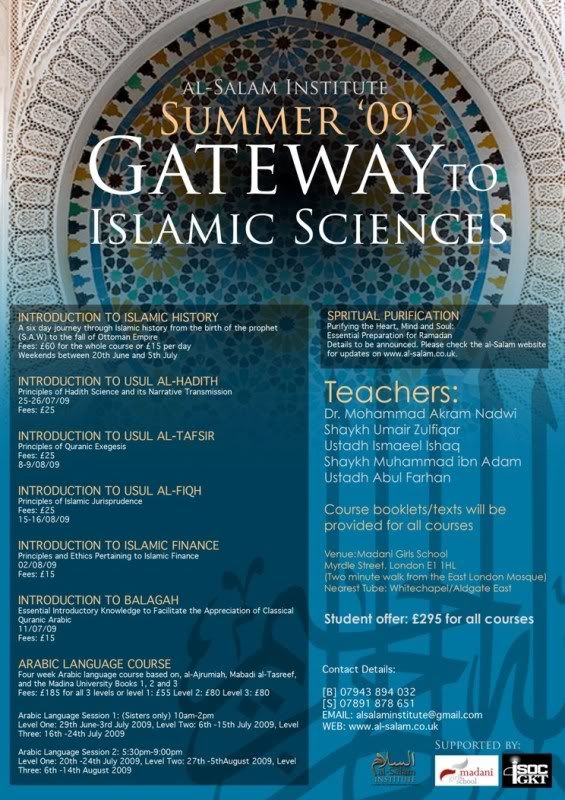
[Event] Summer Special: Gateway to Islamic Sciences

Bismillahir Rahmanir Rahim

In the name of Allah, the Most Beneficent, the Most Merciful


Assalamu 'alaykum wa rahmatullahi wa barakatuhu


More info....


The Prophet sal Allahu alayhi wa'sallam said:

"The Muslim is a unique Ummah among the whole of mankind:
Their Land is ONE, their War is ONE, their Peace is ONE,
Their Honour is ONE and their Trust is ONE."
[Ahmad]

[Event] London: Fundamentals of Understanding the Glorious Qur’an, 27th-28th June, Al-Azhar Academy, Sh. Riyadh ul Haq

Bismillahir Rahmanir Rahim

In the name of Allah, the Most Beneficent, the Most Merciful


Assalamu 'alaykum wa rahmatullahi wa barakatuhu


||Click here for more information ||


The Prophet sal Allahu alayhi wa'sallam said:

"The Muslim is a unique Ummah among the whole of mankind:
Their Land is ONE, their War is ONE, their Peace is ONE,
Their Honour is ONE and their Trust is ONE."
[Ahmad]

Tuesday, 12 May 2009

Do not be envious of one another....

Bismillahir Rahmanir Rahim

In the name of Allah, the Most Beneficent, the Most Merciful


Hadith 35 Arabic text

Abu Hurairah, radiyallahu 'anhu, reported that the Messenger of Allah, sallallahu 'alayhi wasallam, said:

"Do not be envious of one another; do not artificially inflate prices against one another; do not hate one another; do not shun one another; and do not undercut one another in business transactions; and be as fellow-brothers and servants of Allah.

A Muslim is the brother of a Muslim. He neither oppresses him nor humiliates him nor looks down upon him. Piety is here - and he pointed to his chest three times. It is evil enough for a Muslim to hold his brother Muslim in contempt. All things of a Muslim are inviolable for another Muslim: his blood, his property and his honour."

[Muslim]


background

Unity is one of the greatest objectives of Islam. There are many verses in the Qur'an that urge Muslims to unite. In Surah al-'Imran, Ayah 103, Allah says:

And hold fast, all of you together, to the Rope of Allah (which is Islam) and be not divided among yourselves.

This is a very well-known verse to Muslims. In Surah al-Taubah, Ayah 71, Allah says:

The believing men and women are 'awliya' (loyal) to one another.

There are many other verses in the Qur'an that urge joining unity, as well as verses that forbid disunity. We can see this in the same Surah al-'Imran, Ayah 103, in which Allah says:

….and be not divided among yourselves.

So in the same verse the Muslims are asked to be united and prevented from disunity. The Qur'an contains many such verses, for example: Surah al-'Imran Ayah 105-107; Surah al-Hujurat Ayah 10; Surah al-An'am Ayah 153 and 159; and in Surah al-Rum Ayah 31-32. All of these verses and many others in the Qur'an forbid the division or split of the Muslim community.

Moreover, we have many hadiths that command the Muslims to be united. One hadith is recorded by Imam Muslim: "Verily Allah likes three things for you and disapproves three things for you: He is pleased with you but you worship Him and disassociate anything with him; that you hold fast to the Rope of Allah and not to be scattered (disunited); and He disapproves for you irrelevant talk, persistent questioning, and wasting of wealth."

We find that Islam commands the Muslims to practice things that will bring unity - there are conditions and actions where the Muslims need to perform to accomplish this. At the same time, we also find that there are many actions that Islam forbids because these actions may lead to the disunity of the Muslim ummah. This Hadith 35 falls in the latter category.


lessons

The first action that the hadith forbids is envy (al-hasad). Muslim scholars like Imam Ghazali and others define envy as disliking to see a person receiving a bounty and wishing that he or she (the receipient) would lose it.

Ibn Rajab gives a different and broader definition. He states in his definition that it is part of human nature that a person dislikes anyone to be better than him in virtues. He says that people differ in their attitudes and he lists five categories of envy that people have:

  1. There are some people who will make the effort through action or speech to abolish the bounty received by someone whom they envy.

  2. There are others who will then try to get that bounty transferred to them. So they firstly try to take it away from the person they envy and then they try to get it for themselves. For instance, if a certain person is offered a certain position or authority, the envious one will try to do something by hand or by speech to take away that position or authority from that person. Then he will try to get that status or position transferred to himself.

  3. There are some people who do not make any effort by action or speech to harm the one whom they envy. Ibn Rajab says this category of people can be of two types:

    1. The one who does his best to eliminate the feeling of envy within himself but he cannot overcome it. In spite of this, he keeps fighting and struggling against it. Ibn Rajab says this type of person is excused from punishment.

    2. The one who thinks about envy and practices it again and again. He does not make any effort to fight it even though he does not do any harm by action or speech. But he actually enjoys and practices envy - he wishes that the bounty of the envied one will be lost. Consequently, this person is subject to punishment.

  1. There are those who, whenever they envy someone, do not harm him or her. They do not even wish the loss of the bounty from the envied one. Instead, they make the effort to attain a similar bounty or virtue for themselves. Ibn Rajab says: "If this bounty is wordly virtues or worldly bounties, there is no benefit in that." For example, if you see someone who has a Mercedes, and you try to attain a similar car for yourself, then there is no benefit in that. But if it is a righteous virtue, then it is good.

  2. There are some people who, whenever they feel envy, do their best to stop it and they will do a favour or something good for the person whom they envied. In addition, they will also make du'a for that person until they love him - because envy is usually associated with hatred. They will wish that the envied ones are better than them - they do not bother themselves if others have things which are better than what they have. Ibn Rajab says these people are the best category of true believers since everyone is subject to indulge or be trapped by envy or being envious of others.

Why is envy (hasad) forbidden?

It can cause - by the permission of Allah - harm to others whom are envied. Consequently, they are considered as evil acts in Islam. They can cause - even by just wishing - the harming of a person. It is the virtue of Shaitan. And it is also the virtue of Jews to envy other people. This is mentioned in Surah al-Baqarah, Ayah 109 and in Surah al-Nisa', Ayah 54.

The Prophet, sallallahu 'alayhi wasallam, warned Muslims against envy when he said "Creeping upon you is the diseases of those people before you: envy and hatred. And hatred is the thing that shapes. I do not say it shapes the hair but it shapes the religion. By the One in whose Hand is my soul, you will not enter paradise until you believe, and you will not believe until you love one another. Certainly, let me inform you of that which may establish such things: spread the greetings and peace among yourselves." [Recorded by Imam Ahmad and Al-Tirmidhi]

Since this is a harmful act, Muslims are asked to recite certain Qur'anic verses such as Surah al-Falaq, Surah an-Nas, and Surah al-Ikhlas to protect from envious people. According to the Muslim scholars, it would be preferable to recite them after the five prayers along with Ayat-ul-Kursi.

Al-Tanajush is translated literary as "do not artificially inflate the prices against one another". Najash that is mentioned in this hadith can be interpreted, according to Ibn Rajab, in two ways:

  1. It can be interpreted as bai' al-najash - the trading where a person offers a high price for a certain item not for the sake of buying it but for the sake of raising the price of the item so that in the end it is sold for more than its actual price/worth. This is usually done, even in the Muslim world today, by a previous agreement by the salesman and another person or relative who pretends that he wants to buy. This is done in the stock market or auctions where there is a person who keeps bidding higher prices for an item. He is doing a favour for the person who wants to sell. This is considered as bai' al-najash. The majority of Muslim jurists (fuqaha) say it is valid. However, they say that if the buyer finds that he has been manipulated in a way where the price exceeded drastically over the actual price, then he has the choice of returning the item.

  2. The second interpretation of najash is a broader one, more than merely limiting it to trading. Ibn Rajab says here it means any kind of deceiving actions that will lead to harming others. He adds that all dealings that are conducted in a deceiving way are included here. He quotes Surah Fatir, Ayah 43 : "That the evil plot encompasses only him who makes it."

Ibn Rajab says that this hadith is a warning to Muslims not to hate one another, especially if it is because of self-interest. Why? Because Muslims are brothers in Islam. They should love each other and should not hate one another. Consequently, al-nameemah, backbiting and slander are forbidden because they will lead to hatred among the Muslim community. Ibn Rajab says that when the Muslims started dividing into different sects because of conflicting views regarding certain religious matters, this led to disputes and hatred among the community, and thus disunity.

We should not turn our backs on one another. Ibn Rajab says this means any form of disassociation. He says that the Prophet, sallallahu 'alayhi wasallam, said the Muslim is not allowed to disassociate himself from the others for more than three days. This is, as Ibn Rajab points out, in worldly matters. Whereas in the religious matters, disassociation is one of the punishments that Islam allows - e.g. to disassociate with those who commit sins in order to teach them a lesson. But scholars say that if the person who commits the sin is not likely to come back to the right path, then it is meaningless to disassociate with him. As one of the scholars pointed out, if the objectives of Islam are not fulfilled then disassociation is meaningless.

We should not undercut one another in business transactions. For example, if someone is trying to buy something from a salesman, in the middle of their negotiations another salesman appears and interferes and tries to get that customer to buy his product/service instead. This kind of transaction is forbidden because the customer has yet to make his final decision - it will lead to the disunity of the Muslim community.

The Prophet, sallallahu 'alayhi wasallam, asks us to be brothers to one another. Ibn Rajab says this is like justifying the actions that are mentioned by the Prophet, sallallahu 'alayhi wasallam, because these evil acts will lead to spoiling the brotherhood of the Muslims. If Muslims avoid these evil acts, then this will lead them to be brothers. Moreover, Ibn Rajab says this statement implies that Muslims have to make the effort to do whatever that will lead to achieving this brotherhood. This means fulfilling all the obligations towards Muslims, for example like returning the greetings, visiting the sick, helping the needy, accepting invitations, sending presents, shaking hands, and smiling.

Then the Prophet, sallallahu 'alayhi wasallam, says the Muslim is the brother of another Muslim. Ibn Rajab explains about this statement: "It is now obligatory for each brother that he tries to benefit his Muslim brother and to refrain from harming them." He adds that the major harm is oppression and injustice. If a Muslim is in need of your support and you fail to support or help him, this is unjust. There are many places in the Muslim world where the Muslims are in great need of help. They are being oppressed and nobody supports them. Accordingly, if we are not doing anything to help them, we are failing our Muslim brothers. We need to be united to solve the problems that we are facing today. Our main concern should be the unity of the ummah. A contemporary scholar, Abdurrahman Al-S'adi, says that one of the greatest forms of jihad is to make an effort to unite the Muslims. He states that cooperation among Muslims is an obligation.

We should not lie to our Muslim brothers. We should also refrain ourselves from belittling or making fun of other Muslims. We should not make signals or gestures that threaten the face value of our Muslim brothers. We should take care not to be cynical to others and not to undermine other Muslims.

The Prophet, sallallahu 'alayhi wasallam, says taqwa is in the heart. Ibn Rajab comments on this statement saying it is evidence that the most noble among people are the ones who are righteous even if they are not lucky in the sight of other people. If they are righteous, they are the most noble in the sight of Allah.

It can be said that all that has been mentioned in this hadith has to do with the heart: loving Muslims, and not to envy them. When we have taqwa in our hearts, we will not do the forbidden acts mentioned - our hearts will be purified and filled with love.


conclusion

"All things of a Muslim are inviolable for another Muslim: his blood, his property, and his honour." This important last statement, which was mentioned by the Prophet, sallallahu 'alayhi wasallam, in his farewell sermon (hajat alwadaa'), concludes or summarises what this hadith is about. This hadith clearly states that harming others either by saying or doing is considered an evil act. Allah says:

And those who annoy believing men and women undeservedly, they bear on themselves the crime of slander and plain sin.
[Surah al-Ahzab: Ayah 58]

Allah made the believers as brothers so that they have mercy upon one another; so that they love one another; so that they help one another and support one another. This is how Muslims should be.


Source: FortyHadith.com


The Prophet sal Allahu alayhi wa'sallam said:

"The Muslim is a unique Ummah among the whole of mankind:
Their Land is ONE, their War is ONE, their Peace is ONE,
Their Honour is ONE and their Trust is ONE."
[Ahmad]

Tuesday, 5 May 2009

And those who, when they commit an indecency or do injustice to their souls...

Bismillahir Rahmanir Rahim

In the name of Allah, the Most Beneficent, the Most Merciful


“And those who, when they commit an indecency or do injustice to their souls, remember Allah and ask forgiveness for their sins – and who forgives sins but Allah – and (who) do not knowingly persist in what they have done. For such the reward is forgiveness from their Lord, and Gardens with rivers flowing underneath – an eternal dwelling. How excellent a recompense for those who work (and strive)!”
[ Sûrah Âl `Imrân : 135-136]


The Prophet sal Allahu alayhi wa'sallam said:

"The Muslim is a unique Ummah among the whole of mankind:
Their Land is ONE, their War is ONE, their Peace is ONE,
Their Honour is ONE and their Trust is ONE."
[Ahmad]

Wednesday, 22 April 2009

We women, are restricted, home bound, yet men are able to many good deeds....

Bismillahir Rahmanir Rahim

In the name of Allah, the Most Beneficent, the Most Merciful


One day Asma bint Yazid ibn Al-Sakan RadiAllahu anha came to the Prophet (salAllahu alayhi wasalam) as he was sitting with a number of his companions.

Addressing him, she said:


"Messenger of God, may both my parents be sacrificed for you. [This was a traditional phrase of endearment, used mostly figuratively].’ I am an emissary from women to you. God has sent you as His messenger to both men and women. We believe in you and your Lord. Yet we, women, are restricted, home bound. We stay in your (i.e. men’s) homes, give you your pleasure, and bear your children. You, men, have been favored over us with attending Friday prayer and congregational prayers in mosques, visiting the sick, attending funerals, offering the pilgrimage repeatedly, and with what is more than that: fighting for God’s cause.

When a man goes out intending pilgrimage or jihad, we take care of your property, sew your clothes, and bring up your children for you. Do we have a share of your reward?"


The Prophet (salAllahu alayhi wasalam) turned to his companions asking them:
"Have you ever heard a better statement by a woman than this one who is asking about matters of her faith?"

They said: "We would not have thought that a woman would ever be able to express such meanings as this lady."

The Prophet turned to Asmaa and said: "Listen, woman, and inform other women who sent you that a woman who is a goodly wife, keen to please her husband and doing what he likes is equal to all that." As she left, she was glorifying God and repeating statements of His oneness.


[Source]


The Prophet sal Allahu alayhi wa'sallam said:

"The Muslim is a unique Ummah among the whole of mankind:
Their Land is ONE, their War is ONE, their Peace is ONE,
Their Honour is ONE and their Trust is ONE."
[Ahmad]

Monday, 20 April 2009

[Event London] The 5 Questions on The Day of Judgement

Bismillahir Rahmanir Rahim

In the name of Allah, the Most Beneficent, the Most Merciful


The Prophet sal Allahu alayhi wa'sallam said:

"The Muslim is a unique Ummah among the whole of mankind:
Their Land is ONE, their War is ONE, their Peace is ONE,
Their Honour is ONE and their Trust is ONE."
[Ahmad]

Thursday, 26 March 2009

A Contented Life

Bismillahir Rahmanir Rahim

In the name of Allah, the Most Beneficent, the Most Merciful


A Contented Life

Let the days pass as they will
Be content with Allah’s will.
Do not regret what this day’s cast,
For this world’s pains for sure won’t last.
Be a man against fears strong,
Be kind and loyal, all life long.
If in folk’s eyes your faults abound,
And you wish that they be gowned:
Then shelter seek beneath kind acts,
For kindness well all blame retracts.
From enemies hide your weakness
For gloating foes do bring distress.
From misers never seek favor:
In fire there is no water.
Patience won’t reduce income,
Nor fretfulness increase the sum.
Neither pain nor joy shall last,
Nor poverty, nor riches vast.
But if your heart is satisfied
Then you do own the whole world wide.
A man on whom his fate alights
No depths shall save, nor any heights.
Allah’s earth is wide, but know,
That destiny makes it narrow.
Face each day on even keel.
There’s no balm from death can heal.

[Imam al-Shafi`i]


The Prophet sal Allahu alayhi wa'sallam said:

"The Muslim is a unique Ummah among the whole of mankind:
Their Land is ONE, their War is ONE, their Peace is ONE,
Their Honour is ONE and their Trust is ONE."
[Ahmad]
Friday, 6 March 2009

The Relief of the Heart and Body lies in obedience to Allâh

Bismillahir Rahmanir Rahim

In the name of Allah, the Most Beneficent, the Most Merciful


The Relief of the Heart and Body lies in obedience to Allâh

Imaam ibn al-Qayyim al-Jawziyyah rahimahullaah

From 'al-Fawâ'id'. Translated by Abu Rumaysah

In this lies a great secret from the secrets of Tawheed. This is that the heart cannot become firm, it cannot find satisfaction and it cannot find tranquillity except by reaching out to Him. Everything that is loved and desired besides Him then it must be desired for other than His sake. The One Who is desired, the One Who is beloved in and of Himself, with Whom all matters find their final goal is only one. It is impossible that the final goal be to two destinations just as it is impossible that the beginning of the creation be from two sources.

So the one whose love, desire, will and obedience ends at other than Him then it will be rendered null and void, it will disappear and split off from him no matter how great his need be of it. However the one whose love, desire, will, obedience, awe and reverential fear ends at Him, far removed is He from imperfection, will find himself winning His favours, bliss and rapture, magnificence and splendour, and felicity for eternity.

The servant continuously finds himself altering between the laws of commandments and the laws of decree. Therefore he is perpetually in need of aid to fulfil the commandments and in need of kindness and leniency at the onset of the calamity. It is the extent to which he establishes the obligations that determine how much kindness the servant will receive at the onset of the calamity. Therefore if he completes his obligations both inwardly and outwardly then he will attain kindness and leniency both inwardly and outwardly. If, however, he merely establishes the outward form [of the commandments] without establishing their reality [inwardly] then he will receive an outward kindness and his portion of inward kindness will [greatly] diminish.

So if it is asked: what is this inward kindness?

[I say in reply:] It is what the heart attains of tranquillity and satisfaction at the onset of the calamity and the removal of unrest, confusion and despair. Therefore the servant surrenders and submits himself before his Lord and Master and he emerges in a state of complete rest and tranquillity - looking on at Him with his heart, and his soul at peace. His witnessing His Kindness has distracted him from the severity of the situation. His knowledge of Allâh's excellent choice and decision for him diverts him from feeling the calamity just as does his knowledge that he is nothing but a mere servant upon whom the decrees of his Master take effect, and he can either be pleased with them or angry with them. So if he is pleased then he will attain Pleasure and if he is displeased then his portion is nothing save Displeasure. Therefore this inward kindness is the fruit of this inward action [of being pleased with the decree of Allâh], it increases with its increase and decreases with its decrease.


The Prophet sal Allahu alayhi wa'sallam said:

"The Muslim is a unique Ummah among the whole of mankind:
Their Land is ONE, their War is ONE, their Peace is ONE,
Their Honour is ONE and their Trust is ONE."
[Ahmad]

Some Words to Heal the Broken Heart

Bismillahir Rahmanir Rahim

In the name of Allah, the Most Beneficent, the Most Merciful


Some Words to Heal the Broken Heart

Shaykh ul-Islaam ibn Taymiyyah rahimahullaah

Taken from "Diseases of the Hearts and their Cures"

As for the sickness of desire and passionate love then this is the soul loving that which would harm it coupled with this is a hatred of that which would benefit it.

Passionate love is a psychological sickness, and when it’s effects become noticeable on the body, it becomes a sickness that afflicts the mind also. Either by afflicting the mind by the likeness of melancholy, or afflicting the body through weakness and emancipation. But the purpose here is to discuss its effect on the heart, for passionate love is the fundament that makes the soul covet that which would harm it, similar to the one weak of body who covets that which harms it, and if he is not satiated by that then he is grieved, and if he is satiated then his sickness increases. The same applies to the heart afflicted with this love, for it is harmed by its connection to the loved, either by seeing, hearing, touching or even thinking about it. And if he were to curb the love then the heart is hurt and grieved by this, and if he gives in to the desire then the sickness becomes stronger and becomes a means through which the grievance is increased.

In the hadeeth concerning the saying of Moosa reported by Wahb*, which is recorded by Imam Ahmad in az-Zuhd:

Allah says: Indeed I drive away My friends from the delights of this world and its opulence and comfort just as the compassionate shepherd drives away his camel from the dangerous grazing lands. And indeed I make them avoid its tranquility and livelihood, just as the compassionate shepherd makes his camel to avoid the resting placers wherein it would be easy prey. This is not because I consider them to be insignificant, but so they may complete their portion of My kindness in safety and abundance, the delights of the world will not attract him and neither would desires overcome him.

*Wahb ibn Munabbih is a noble taabi’ee, but this hadeeth is reported from him directly to the Prophet (saaw) and is not authentic.

Therefore the only cure for the sick lies in his removing the sickness by removing this blameworthy love from his heart.

There are some whose hearts contain the disease of desire and whose perceptions are only skin deep. When the object of the desire submits, the sickness is satiated, and this satiation strengthens the desire and pursuit of the object and hence strengthens the sickness. This is in contrast to the one whose objective is not met, for this failure results in the removing the satiation that would strengthen the sickness and thereby the desire is weakened, as is the love. This is because the person definitely intends that there be action accompanying his desire, for otherwise all his desire would be is just whisperings of the soul, unless there is some speech or looking accompanying this.

As for the one who sis afflicted with this passionate love but holds back and is patient, then indeed Allah will reward him for his taqwa as occurs in the hadeeth:

That the one who passionately loves someone yet holds back, conceals this and is patient, then dies upon this, will be a martyr.

(A da’eef hadeeth . refer to the discussion concerning its authenticity in al-Jawaab al-Kaafee and Rawdha al-Muhibbeen of Ibn al Qayyim and Silsilah ad-Da’eefah of al-Albaanee.)

This hadeeth is known to be the report of Yahya al-Qataat from Mujaahid from Ibn Abbas from the Prophet (saaw) but it is problematic and such a hadeeth is not to be depended upon.

But it is known from the evidences of the Shareeah that if one were to hold back from performing that which is unlawful, be it looking, speaking or acting, and he conceals this and does not articulate it so as not to fall into that which is prohibited and he is patient in his obedience to Allah and keeps away from disobedience to Allah, despite the pain that his heart feels due to this passionate love (similar to the case of the one who is patient through a calamity), then indeed this person would gain the same reward as those who have feared Allah and been patient.

Verily, he who fears Allah and is patient, then surely Allah makes not the reward of the doers good to be lost. [Surah Yusuf: Ayah 90]

But as for him who feared the standing before his Lord, and restrained himself from impure evil desires and lusts. Verily, Paradise will be his abode. [Surah an-Naaziaat: Ayah 40]

When the soul loves something, it will do all it can to attain it, so the one who does this out of having a blameworthy love or hatred then this action of his would be sinful. For example, his hating a person due to envying him and thereby harming whosoever is linked to that person.

As one poet affected by this said:

For the sake of a Sudanese girl he loved Sudan to the point that he loved the black dogs due to his love of her.

Ibn al Qayyim al Jawziyyah’s al Fawaaid (p111-112)

“The slave is not afflicted with a punishment greater in severity then the hardening of the heart and being distant from Allah. For the Fire was created to melt the hardened heart. The most distant heart from Allah is the heart which is hardened. If the heart becomes hardened, the eye becomes dry.

If four matters are exceeded in quantity, beyond what is necessary, the heart shall become hardened:

Food, sleep, speech and sexual intercourse. A body afflicted by disease does not derive nourishment from food or water, similarly a heart diseased by desire does not benefit from admonishment and exhortation.

Whosoever desires to purify his heart, then let him prefer Allah to his desires.

The heart which is clinging to its desires is veiled from Allah, commensurate to the degree that it is attached to them, the hearts are the vessels of Allah upon his earth, hence the most beloved of them to him, are the ones most compassionate, pure and resistant to deviation.

They (the transgressors) preoccupied their hearts [in the pursuance] of the Dunya, would that they preoccupied them with Allah and the hereafter, then surely they would have reflected upon the intended meaning of his poignant words and verses. Their hearts would have returned to their masters with wisdom, marvelously curious and [in possession] of the rarest of precious gems.

If the heart is nourished with remembrance, its thirst quenched with contemplation and cleansed from corruption, it shall witness remarkable and wondrous matters, inspiring wisdom.

Not every individual who is endowed with knowledge and wisdom, and assumes its character is form amongst its people. Rather the people of knowledge and wisdom are those who infused life into their hearts by slaying their desires. As for the one who slays his heart and vitalized his desires, then knowledge and wisdom is naked upon his tongue.

The destruction of the heart occurs by security [in this Dunya] and negligence, its fortification occurs by fear and remembrance. If the heart renounces the pleasures of the Dunya, it settles upon the [pursuance of] pleasures of the Hereafter, and amongst those who call towards it.

Should the heart become content with the pleasures of the Dunya, those pleasures [of the hereafter] cease [to continue].

Yearning for Allah and his meeting is like the gentle breeze blowing upon the heart, extinguishing the blaze of the Dunya. Whosoever caused his heart to settle with his Lord shall be in a state, clam and tranquil, and whosoever sent it amongst the people shall be disturbed and excessively perturbed.

For the love of Allah shall not enter a heart, which contains the love of this world, except as a camel, which passes through the eye of a needle.

Hence, the most beloved servant before Allah is the one whom He places in His servitude, whom He selects for His love, whom He causes to purify his worship for Him, dedicates his objectives for Him, his tongue for His remembrance, and his limbs for His service.

The heart becomes sick, as the body becomes sick, and its remedy is al-Tawbah and protection [from transgression].

It becomes rusty as a mirror becomes rusty, and its clarity is obtained by remembrance. It becomes naked as the body becomes naked, and its beautification is at-Taqwa. It becomes hungry and thirsty as the body becomes hungry and thirst, and its food and drink are knowledge, love, dependence, repentance and servitude.”


The Prophet sal Allahu alayhi wa'sallam said:

"The Muslim is a unique Ummah among the whole of mankind:
Their Land is ONE, their War is ONE, their Peace is ONE,
Their Honour is ONE and their Trust is ONE."
[Ahmad]

The Hunt of Thought

Bismillahir Rahmanir Rahim

In the name of Allah, the Most Beneficent, the Most Merciful


The Hunt of Thought

Imaam Ibn al-Jawzee rahimahullaah


The wisdom behind delaying the answer for a supplication:

It is puzzling your insistence on asking for your desires and when ever they were delayed your insistence increase without thinking that your are not granted what you ask for because of:

1. Your benefit (for what you have asked could be a harm to you in a way)

2. Your sins (for the sinner's prayers are not answered).

If it was the second reason, you will have to clear the path of answering from the stains of sins. If it was the first reason then look at what you ask for:

Is it to strengthen your religion, or just a plain earthly desire? If it was only an earthly desire, then know that it is the kindness and the mercy of Allah that delayed it for you, and by your insistence, you are like a child that asks for what harms him and he is denied that for his own good. And if you think that what you asked for is for the benefit of your religion then your benefit could be in delaying it, or the well-being of your faith is by the nonexistence of it.

In other words, the planning of the Truth the Almighty (Allah) is better for you than your own planning, and He could deprive you from what you ask to test your patience. So let Him see from you a determined patience and you will soon see from Him what will give you joy. And when you have cleaned the paths of answering (of supplication) from the stains of sin and was patient about what He has chosen for you, then every thing that happens to you is better for you weather you were given or deprived of what you have requested.


SunnahOnline


The Prophet sal Allahu alayhi wa'sallam said:

"The Muslim is a unique Ummah among the whole of mankind:
Their Land is ONE, their War is ONE, their Peace is ONE,
Their Honour is ONE and their Trust is ONE."
[Ahmad]

Tuesday, 3 March 2009

[Audio Download] Yusuf (AS) - Exploring the Chapter of Joseph in the Holy Quran

Bismillahir Rahmanir Rahim

In the name of Allah, the Most Beneficent, the Most Merciful

Yusuf (AS) - Exploring the Chapter of Joseph in the Holy Quran


This 4 CD set aims to show how the story of Yusuf (AS) int he Holy Qur'an can be a source of guidance and inspiration for today. It goes beyond the usual verse-by-verse commentaries and instead focuses on the major themes of his life; his childhood in Palestine; his life in the palace of al-Aziz; his time in prison; and finally his ascension to power in Egypt. Presented by the renowned historian Dr Hesham Al Awadi, who has researched numerous works on the chapter of Joseph in the Holy Qur'an, this CD set captures with vividness prophet Yusuf's (AS) various encounters with jealousy, greed, seduction, injustice and the allures of power and fame. In a style that combines both depth and practicality, the story is relayed and reinvigorated to relate to our modern lives.


Download


The Prophet sal Allahu alayhi wa'sallam said:

"The Muslim is a unique Ummah among the whole of mankind:
Their Land is ONE, their War is ONE, their Peace is ONE,
Their Honour is ONE and their Trust is ONE."
[Ahmad]